

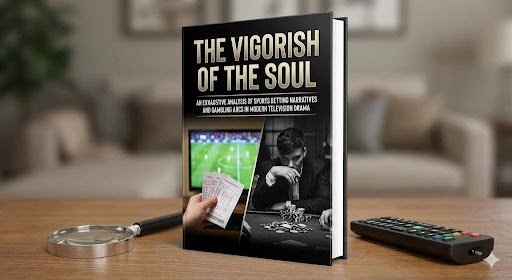
Few tropes in the vocabulary of prestige television carry as much narrative weight as the sports betting arc. What once served as a noir shorthand for vice has evolved into a powerful storytelling engine—shaping character psychology, driving plot tension, and exploring capitalism, destiny, masculinity, and control.
From the smoky backrooms of The Sopranos to the digitized anxiety of Bookie, gambling has become a metaphor for the human condition. A successful bet confirms a worldview; a loss dismantles it. This is the power of the vig—not just financial, but spiritual.
1. The Existential Bookmaker: The Sopranos and the Burden of the Vig
The Sopranos by HBO has set the benchmark of the griminess of the gambling economy long before sports betting apps became a mundane daily routine of checking NFL or NBA odds. The show does not make the life of the bookmaker seem glamorous, rather one tedious collection and calculation.
The Tragedy of Christopher Moltisanti
HBO’s The Sopranos stripped away glamour and presented gambling as arithmetic and asset extraction. Christopher Moltisanti’s existential crisis contrasts sharply with the monotonous reality of running a sports book. The “bust-out” process reveals that for the mob, the real product isn’t the bet—it’s the vigorish.
Tony Soprano: The Whale Who Couldn’t Swim
Tony embodies the gambler as “whale.” In episodes like Chasing It, he chases losses irrationally. His obsession with the “sure thing” mirrors his collapsing control over family and empire. Victory offers fleeting superiority; defeat exposes hollow authority.
2. The Analog Dinosaur in a Digital Age: Bookie
The Gentrification of Vice
Danny is a symbol of the analog man in a digital world. The series is a comparison between the logistical nightmares of his business, which include cash collection, personality, and violence avoidance, and the clean efficiency of legal betting applications. Danny is value-based since he provides empathy (or something like postponement of breaking legs) on an algorithmic level.
It is also shown in the show as a rare and accurate glimpse into the so-called layoff, where a bookie bets with another bookie to equalize his/her risk. In the episode, Some Whales Nix the Vig, Danny is compelled to sweat over a meaningless football game, owing to his life being counted in a field goal. This underscores how weak the local bookie is because, unlike the giant corporations that are able to price the NBA odds and NFL lines nowadays, he does not have an unlimited safety net.
The Charlie Sheen Factor
The fictionalized Charlie Sheen character embodies gambler’s fallacy. Danny becomes less a bookie and more a therapist—managing ego and chaos to preserve cash flow.
3. The Delusional Optimist: Ray Donovan
The “Sure Thing” Philosophy
Mickey Donovan treats betting as spiritual destiny rather than mathematics. His belief that the universe “owes” him illustrates magical thinking common among addicts.
The Hector Campos Fix
In season 4’s “Chinese Algebra,” Mickey’s reckless multi-million-dollar wager devolves into absurd chaos. The arc reinforces the show’s thesis: chaos is constant, and nothing is ever truly fixable.
4. The Intellectual Addicts: Luck
The Anatomy of the “Foray”
David Milch’s Luck portrays horse racing with poetic realism. Jerry, the handicapper, studies bloodlines and track conditions with academic precision. Yet when he wins millions, money amplifies pathology rather than curing it. Luck is treated as a limited resource to be exploited before it evaporates.
5. The Historical Masterminds: Boardwalk Empire and Peaky Blinders
Arnold Rothstein: The Architect of the Fix
In Boardwalk Empire, Rothstein reframes gambling as controlled business. “I never bet on anything I can’t control” becomes the mantra of gambling’s corporate evolution.
Tommy Shelby: The Industrialist
Peaky Blinders charts Tommy Shelby’s transition from race-fixing thug to legitimate bookmaker. He recognizes legalization as the endgame—transforming chaos into enterprise.
6. The Wall Street Casino: Billions
Dollar Bill and the Alpha Wager
Billions proposes that high finance is simply gambling in tailored suits. Dollar Bill Stearn chases “the edge” with the psychology of a casino regular. Quant models resemble gambler systems—an illusion of control over randomness.
7. The Desperate Flier: Squid Game and Shameless
Seong Gi-hun’s Catalyst
The world phenomenon Squid Game opens with a typical tragedy about sports betting. We are introduced to Seong Gi-hun at the horse track, where he steals the money from his mother to make a bet against a long shot. The visceral cycle of the bettor—superstition, euphoria, and crushing despair—is established immediately. He is the ideal candidate to participate in the death games because of his background as a degenerate gambler. He is already conditioned to take high risks (his life) in exchange for high rewards (the prize money).
Frank Gallagher’s Poverty Wager
Frank Gallagher is the lowest in the food chain in Shameless. He considers his own children collateral since he once bet his toddler son in a pool game. The character of Frank shows the predatory nature of the addict. Even after he stumbles into a six-figure insurance settlement, he spends it in a fugue state of action. For Frank, the money is irrelevant; he is only truly alive when he is on the edge of ruin.
8. The Financial Athletes: Ballers
The Vegas Move
Ballers blurs the line between athlete management and wagering economics. Spencer Strasmore evaluates players like portfolio assets. His push to bring an NFL team to Las Vegas anticipates the merging of professional sports and legalized betting—a future now fully realized.
Conclusion: The Vigorish of the Soul
Across these series, gambling evolves from criminal subplot to existential metaphor. Whether mobsters, hedge fund managers, or desperate fathers, each character confronts the same truth: the vig is more than a fee—it is the cost of illusion. Television uses betting not merely to show risk, but to examine belief, control, and the fragile stories we tell ourselves about winning.
Source link