

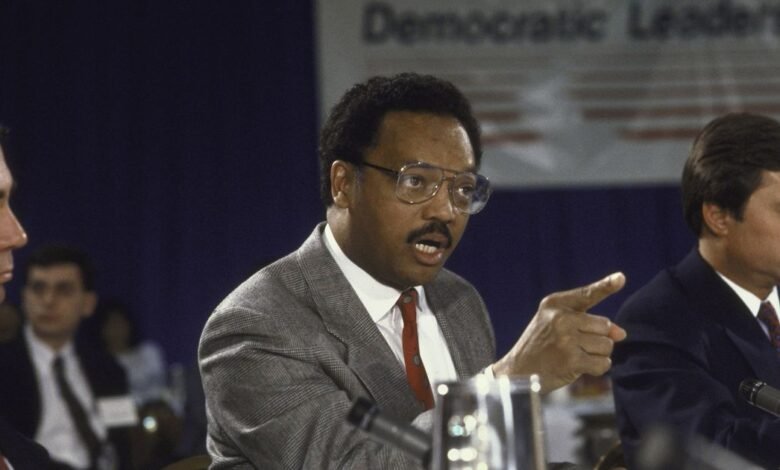

Jesse Jackson tells Democratic centrists it takes “two wings to fly.”
Photo: Bill Foley/Getty Images
As a longtime Democratic National Convention staffer, I have two ineradicable memories of the Reverend Jesse Jackson, who died yesterday at the age of 84. The first was a famous moment at the 1988 convention, when, after a hard-fought primary season, he endorsed nominee Michael Dukakis in what everyone instantly recognized as the best speech of the entire campaign cycle.
The second was a quiet, behind-the-scenes moment at the 2000 convention, when Jackson entered a rehearsal room where I was working. The last thing he needed was a rehearsal, and it turned out he showed up only so his wife, Jacqueline, could stand behind the rehearsal podium and get a sense of what it was like to address a national convention.
Whether in a huge arena or a small room, Jackson commanded attention wherever he went and represented a challenge to anyone complacent about the Democratic Party or America itself. Now that he’s gone, it’s appropriate to assess his political legacy. As a former policy director of the centrist Democratic Leadership Council — a group Jackson often criticized and once excoriated as “Democrats for the leisure class” — I feel particularly compelled to express appreciation for his accomplishments, which were sometimes easy to underappreciate in the heat of intraparty conflict. Without question, he was the best orator of his generation. But he aimed, and succeeded, at so much more than words.
First and most obvious, Jackson proved a Black politician could run a viable presidential campaign. In 1984, he was the first significant Black presidential candidate since Shirley Chisholm in 1972 and much more successful as a vote getter. In 1988, his campaign rose to another level, winning over 6 million votes, 13 primaries or caucuses, and over a thousand delegates, making him the clear runner-up to the nominee. By the time the Democratic convention of 2004 rolled around, the two big oratorical stars were Jackson protégé Al Sharpton and the dazzling young state senator from Jackson’s hometown, who would become president just four years later. (As Barack Obama rightly said yesterday, “We stood on his shoulders.”)
By 2020, two Black candidates ran major presidential campaigns and Black political self-expression was secure enough that Black voters were crucial in awarding the nomination to Joe Biden. When the second Black presidential nominee was named in 2024, her gender was probably more controversial than her race. None of this would have been possible without Jackson.
Second, Jackson presented a vision of the Democratic Party as a “rainbow coalition” of interest and identity groups united around a progressive agenda. This seems rather unremarkable today, but when Jackson was at his peak in influence, Democrats had a severe identity crisis over the loss of traditional voting blocs like white southerners and white ethnic Catholics and was focused more on trying to win them back than on looking for new constituencies. Jackson’s campaigns helped turn Democrats toward their own future.
And while Jackson could battle with the best of them for the “soul of the Democratic Party,” he was a pragmatist, too. He once told a DLC conference the party needed “two wings to fly,” and his support for Bill Clinton’s presidential campaigns was crucial.
But third, it’s important for self-identified centrists like me to admit that Jackson was right and we were wrong about some important policy issues. As New Republic editor Mike Tomasky points out in his assessment of the Jackson legacy, there was a pointed edge to the “two wings to fly” message:
“It takes two wings to fly,” I remember Jackson saying regularly at the time, reminding the dominant centrists that there were Democrats who were leery of free trade, angry about this new problem of income inequality, perfectly happy with big government, and eager to see their party defend unions and workers.
The centrists called the shots for a long time. But 30 years on, who’s won that economic argument? On the four matters I name above, and a few more, it’s Jackson’s positions that are today ascendant. And it all traces back to his brave decision to confront Reaganism head-on at the precise moment that it was at its most triumphant. Jackson was a man of many accomplishments, and yes, a fair share of flaws. But for that decision, he deserves our thanks, and history’s respect.
Democrats today call for renewed courage in the face of great adversity, an unalloyed commitment to progressive values like inclusion and equality, a connection with the great social movements of the past, and yes, the ability to speak compellingly with some poetry as well as prose. Donald Trump’s MAGA movement is the heir to the 20th-century reactionary movements Jackson grew up battling. The struggle to overcome it is very much part of his legacy too.
Source link