

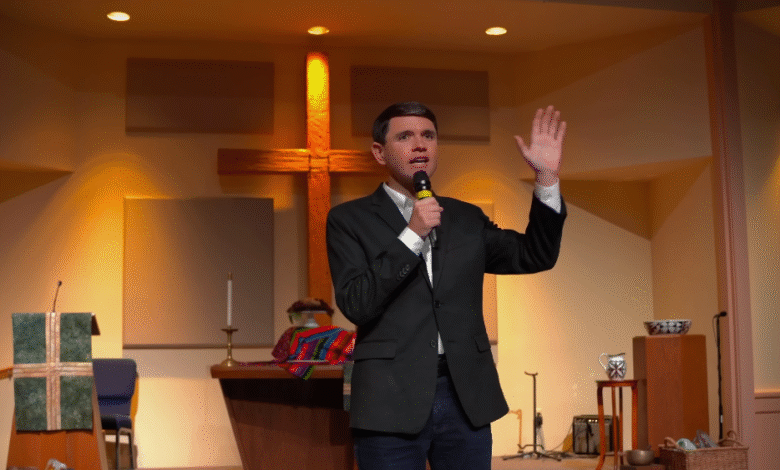

Photo: YouTube/@JamesTalarico
Texas Democratic U.S. Senate nominee James Talarico has gotten a lot of positive (or at least curious) attention for his willingness to criticize Christian nationalism and champion church-state separation from a specifically Christian point of view. It is sort of his signature and is often thought to be central to his ability to reach out beyond the ranks of secular liberals and speak to swing voters and even MAGA folk in a religious vocabulary that is familiar to them.
But his outspokenness on providing a fresh and progressive interpretation of the gospel of Jesus Christ has invited a counterattack from the conjoined forces of the Republican Party and conservative Christianity. This earnest Presbyterian seminarian will likely be attacked not just as a woke liberal but as a heretic, a man pretending to be a Christian who actually worships false gods.
The first salvo of this religiopolitical offensive came on primary night, even before the race had been officially called for the Austin state legislator:
Though the use of the “woke” term “nonbinary” may have been novel, the idea that God is a supreme being beyond gender is not terribly new or (at least in nonfundamentalist circles) especially controversial. But both the idea and the term are shocking to religious conservatives and to secular folk, whose view of Christianity has been largely formed by the conservative Christians who have been so successful in dominating the “brand” in recent years. I have no idea if the National Republican Senatorial Committee operatives who put together the snarky little tweet above know a single thing about Christian theology, but they know a good attack line when they hear one.
In the few days since Talarico’s primary win, there has been more scrutiny of unconventional things he has said about Christianity:
Looking at the Gnostic Gospels (written at the same time or even earlier than the canonical New Testament) is a reasonably common practice among Christian thinkers trying to understand issues not directly addressed in the familiar books of the Bible, at least among mainline Protestants like Talarico. But that’s the problem with almost everything Talarico says, including the compatibility of the Gospel with abortion rights and LGBTQ+ rights. It’s a type of Christian teaching little known beyond the pews of mainline Protestant churches, as historian Daniel K. Williams points out:
Talarico’s policy positions and theological statements on the campaign trail are fully in sync with the views of his own congregation and the seminary he attended.
The homepage for St. Andrews Presbyterian Church in Austin (Talarico’s home church) makes no secret of its progressive cultural leanings. It features a photo of a sign saying “We Support Reproductive Rights” on its homepage, as well as another picture of a rainbow stole draped over a cross, with the text, “We believe that every person is a unique creation and a child of God. We affirm the full participation of all ages, sex and gender identities, races, color, and ethnicities in all our endeavors.
These are views I certainly recognize from my own mainline Protestant (Disciples of Christ) church and would be familiar to millions of Presbyterians, Methodists, Congregationalists, Episcopalians, Unitarians, and others. But these are not the faith communities aligned with Donald Trump and the GOP these days, and, as Williams notes, what Talarico is preaching and teaching may be entirely unfamiliar to them:
Because many evangelicals are only dimly aware of liberal Protestant theology and lack a theological category for it, I suspect that many of them will simply label Talarico “not a true Christian” and dismiss his views.
Sure enough, here is what the prominent conservative Christian blog Mere Orthodoxy says about Talarico:
The problem isn’t that Representative Talarico is bringing his faith into politics; it’s that he is bringing a counterfeit faith, one that would be completely unrecognizable to the global and historic Church. To accept the progressive dogmas Talarico attempts to baptize, one must ignore the witness of believers across every century, language, and hemisphere.
The coming war over Talarico is not just a political battle with religious undertones but for some conservative Christians a holy war aimed at denying the legitimacy of liberal Christians and casting them into the outer darkness.
Much as I empathize with Talarico’s views on cultural-war issues, I do fear that his self-confidence about them may lead to the impression that he wants to substitute a dogmatic Christian left for a dogmatic Christian right and cast doubt on the legitimacy of conservative Christian beliefs just as conservatives doubt his. One of his most compelling arguments (central to his now-viral comments in a recent interview with Stephen Colbert) is that Christian love compels respect for different religious views, which is why church-state separation (once, ironically, a central tenet of conservative evangelicalism, especially the powerful Southern Baptist denomination) is important for the church as well as the state. Perhaps he can make it clearer going forward that he’s a noncombatant in the holy war that’s going to be waged against him and like-minded Christians of every tradition who don’t accept that loving God means despising neighbors.