
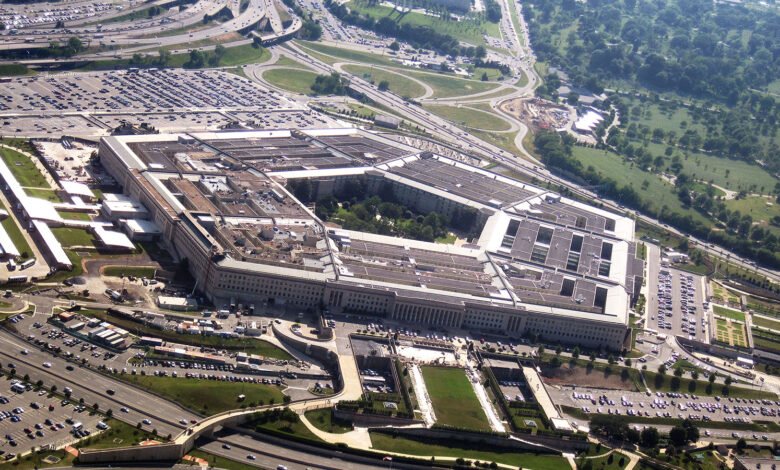
(RNS) — A peculiar meeting at the Pentagon between apostolic nuncio Cardinal Christophe Pierre, who serves as Pope Leo XIV’s U.S. representative, and a senior Department of Defense official has led to a flurry of speculation and concern about the relationship between the Pentagon and the Vatican.
The January meeting was first reported by The Free Press earlier this week, which claimed Pentagon officials warned the Vatican “the United States has the military power to do whatever it wants” and the Catholic Church should take its side. Within hours, the report sparked statements from U.S. and Vatican officials, with varying accounts and interpretations of the meeting emerging over the next day as a wave of discourse erupted among Vatican-watchers and other Catholics.
“It was like inviting a vegetarian to a barbecue,” papal biographer Massimo Faggioli, a professor of ecclesiology at Trinity College Dublin, told RNS on Thursday (April 9). “That is the building where the orders to wage war come from, and that is by itself not a natural place to have a meeting with a representative of a global organization like the Catholic Church, which is known for efforts to stop wars.”
In a statement sent to RNS on Wednesday, the Department of Defense confirmed the meeting occurred but disputed the Free Press’ assessment of what transpired, calling the story highly “exaggerated and distorted.” The Defense Department also wrote on X that Elbridge Colby, under secretary of war for policy, who reports to Secretary Pete Hegseth’s deputy, “had a substantive, respectful, and professional meeting,” with Pierre, where they discussed “issues of morality in foreign policy, the logic of the U.S. National Security Strategy, Europe, Africa, Latin America, and other topics.”
In a separate statement to RNS, the nunciature did not dispute The Free Press’ reporting, but wrote that “meetings with government officials are a standard practice for the Nuncio,” adding that “the Apostolic Nunciature is grateful for the opportunities to meet and dialogue with government officials and others in Washington to discuss areas of mutual concern.”
Late Thursday, the U.S. Embassy to the Holy See published a thread on X saying Pierre had spoken to Brian Burch, the U.S. ambassador to the Holy See, after the Free Press report was published. According to the thread, Pierre allegedly told Burch the media’s portrayal of the meeting “does not reflect what happened” and was “just invented to make a story.” The embassy said Pierre described the meeting as “frank, but very cordial.”
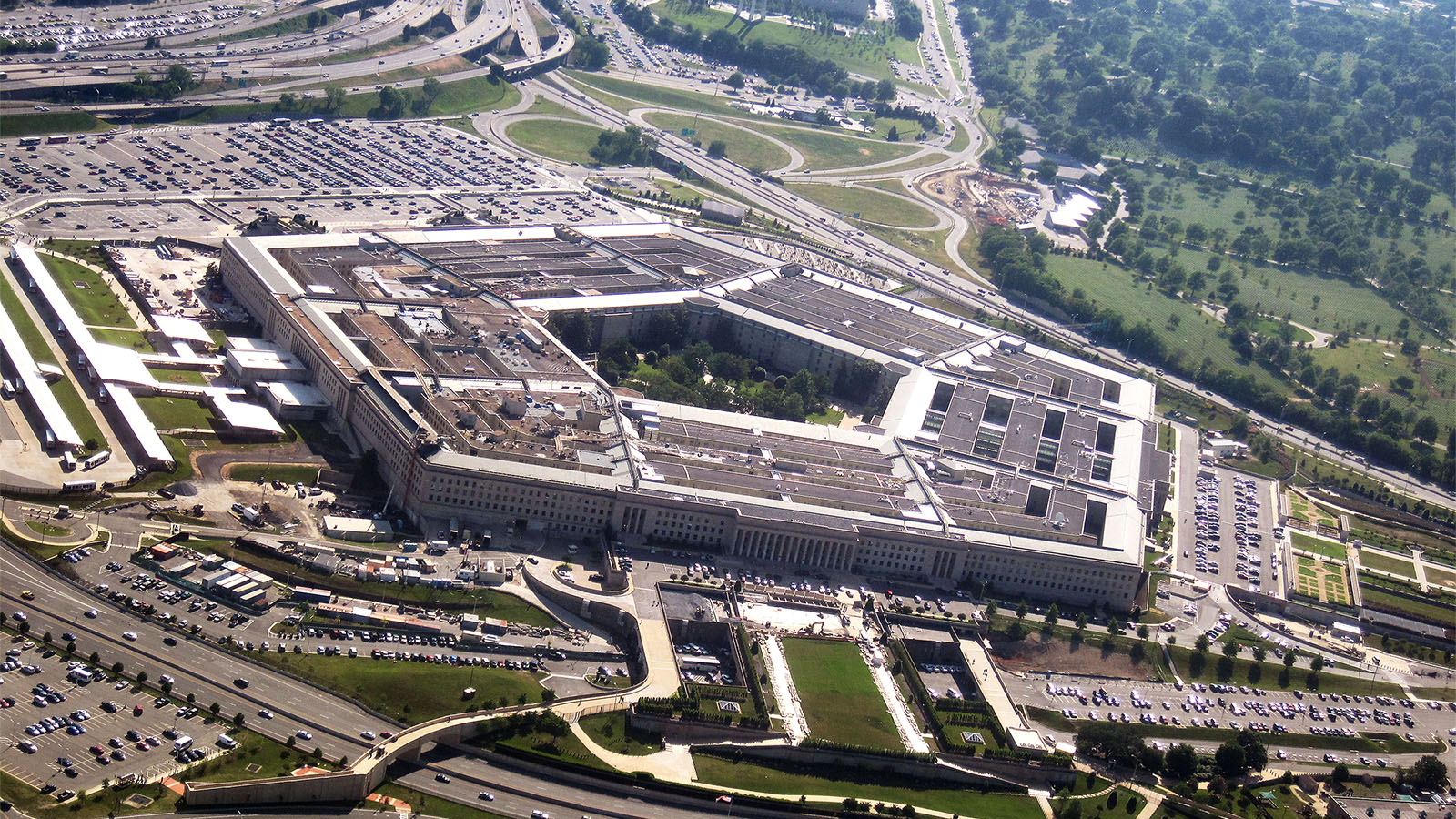
The nuncio’s office did not respond to multiple requests to confirm the account forwarded by Burch and the embassy regarding the alleged conversation with Pierre. However, on Friday, the Vatican press office issued a statement saying the Pentagon meeting occurred “within the regular mission of the Pontifical Representative and provided an opportunity for an exchange of views regarding matters of mutual interest.” The statement also said the “narrative offered by some media outlets regarding this meeting is completely untrue.”
Meanwhile, an X message by a Vatican official, the Rev. Antonio Spadaro, undersecretary for the Dicastery for Culture and Education, may indicate how the Vatican is positioning itself as a bridge-builder, despite increasingly strident anti-war rhetoric from Leo. Spadaro, who acknowledged the meeting was “unusual,” wrote that as “international language is increasingly dominated by the logic of force, deterrence, and security,” Vatican diplomacy aims to present an alternate approach of “listening, dialogue, persistence.”
The Free Press report inspired widespread concern on social media, including from Rep. Ted Lieu, D-California, a Catholic, who wrote on X about concerns the U.S. military would try to attack the Vatican, though most other observers did not seem to expect military action against the Vatican.
Though the Free Press is not known for reporting on the Catholic Church, the reporter behind the story, Mattia Ferraresi, who typically writes for Italian newspaper Domani, is well-regarded by some Vatican experts.
“He has been for many years the New York correspondent of an important Italian newspaper who is very cautious and attentive to American issues,” Faggioli said. “This journalist has important contacts in the United States.”
Faggioli, the author of several books about Pope Francis, Catholicism in U.S. politics, and church history, said that holding such a meeting at the Pentagon was an inappropriate diplomatic gesture, adding to a growing sense among church leaders that the U.S. administration is “destructive.” Though, he said, “This is not the first time that the Trump administration makes gestures that violate certain basic rules of relations with the Vatican.”

However, Faggioli said the impacts of Trump administration policies on immigrant Catholics in the U.S. amid the mass deportation efforts, and Catholics in the Middle East during the Iran war, in addition to impacts on non-Catholics, have moved the church to a new stance. “In some sense, this is the second beginning of Pope Leo’s pontificate,” Faggioli said. “Pope Leo has been more cautious and more disciplined, but he has been pushed out of that caution because the situation has escalated.”
The Free Press reported that DoD officials objected to what they viewed as implied Vatican criticism of the Trump administration’s foreign policy in a January speech to diplomats, when Leo said, “A diplomacy that promotes dialogue and seeks consensus among all parties is being replaced by a diplomacy based on force.”
Much of the debate surrounding the meeting has centered on the allegation in the Free Press reporting that a Pentagon official referenced the Avignon Papacy during the meeting. RNS asked officials at both DoD and the nuncio’s office about the allegation. Officials at the nuncio’s office did not directly respond to the question, and a DoD spokesperson declined to comment. In an X post, Burch claimed that Pierre denied mention of the Avignon Papacy.
Matthew Gabriele, a professor of medieval studies at Virginia Tech, said discussion of the Avignon Papacy unsettles many Catholics because it recalls a particularly bleak period in church history beginning in the 14th century.
“The French king at the time, Philip IV — also known as Philip the Fair because he had fair skin, not because he was particularly nice — exerted pressure on the papacy and basically kidnapped the pope and installed him at Avignon,” said Gabriele, who also runs the “American Medieval” podcast. “Avignon was very convenient for the French king because it was technically still in the lands of the Holy Roman Empire, but very close to the French border. So the French king could exert control over the papacy.”
Gabriele explained that in addition to influencing the pontiff on day-to-day matters, the French king also likely had an impact on the selection of new popes. Unlike modern conclaves, when cardinals eligible to elect a pope are secluded from the outside world, prelates who selected pontiffs at the time were potentially subject to intimidation, including military threats.
“If you had a whole bunch of soldiers in the room — French royal soldiers, for example — you could really decide who becomes the next pope,” Gabriele said. “That’s effectively what happened throughout much of the Avignon Papacy.”
In confirming the meeting, both the U.S. nunciature and the Pentagon specified that the meeting took place on Jan. 22, four days after Timothy Broglio, archbishop of the Military Services, USA, told the BBC it “would be morally acceptable” for troops to disobey an immoral order. Their confirmations contradict the timing the Free Press reported, which portrays Broglio’s comments as occurring after the meeting and part of building tension that ensued afterward.

“I think we need to understand this meeting in the context of the whole illegal orders controversy,” said Peter Campbell, an associate professor of political science at Baylor University in Texas, who studies the military.
Prior to the meeting, the Trump administration had sought a grand jury indictment against six Democratic lawmakers, who appeared in a November video urging U.S. military members to refuse illegal orders, which President Donald Trump suggested in a social media post was an offense “punishable by death.” Michigan Sen. Elissa Slotkin told The New York Times she had organized the video after she had heard concerns from troops about the legality of attacks on alleged drug traffickers.
Campbell said the Pentagon’s messaging about those kinds of comments stem from concerns that the chain of command is being undermined.
Though Broglio did not publicly criticize the Trump administration’s military decisions as president of the U.S. Conference of Catholic Bishops — a post he held until last November — as those legality questions were raised in December, Broglio called the “intentional killing of noncombatants” illegal and immoral.
Broglio’s office did not respond to a request for comment on the January Pentagon meeting.
Campbell speculated that, given the timing of the meeting, “It’s probably just that the Trump administration was trying to let the Vatican know in no uncertain terms that they don’t appreciate what they see as attacks on the policy of the United States when it comes to immigration and when it comes to their war on drugs.”
Some Catholic insiders suspect the precise contents of the meeting will remain a mystery. In a post on X, author and commentator the Rev. James Martin, who also serves as a consultor to the Vatican’s communications department, said he had “no doubt” that government officials “could have spoken bluntly, even rudely, to Cardinal Christophe Pierre.” Even so, he suggested a diplomat at the famously reticent Vatican is unlikely to offer details to the press.
“I highly doubt that Cardinal Pierre, a smart man, a kind priest, and, above all, a consummate diplomat, will ever say anything about what was said on the record,” Martin wrote. “Nor will the Holy See or the current nuncio.”
Source link