
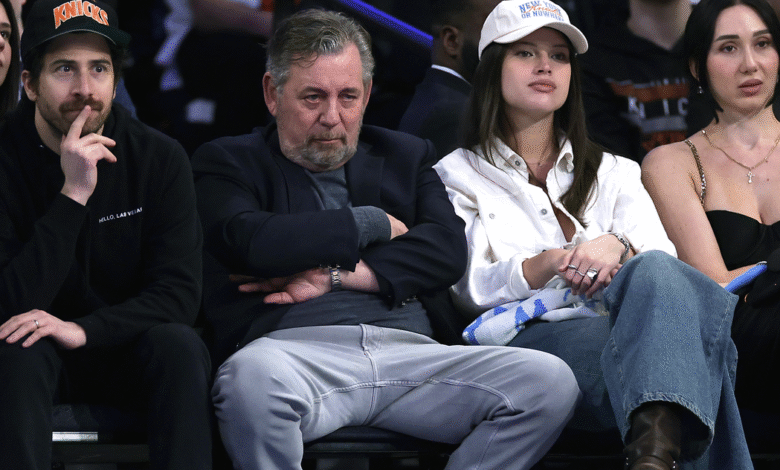

Photo: Adam Hunger/AP Photo
The James Dolan glare is a signature look of supreme disappointment. During bleak moments, he’ll sit slumped in a chair along the baseline at Madison Square Garden, the arena he owns, disapprovingly watching the New York Knicks, the team he owns. The bearded face, scowling and sullen-eyed — the glare is imposing enough in a sprawling arena but must be downright menacing in close quarters.
Several key Knicks players and staff members got a glimpse last spring as Dolan and team president Leon Rose summoned them to deliver opinions on what had gone wrong this time, the 52nd consecutive season that the Knicks had failed to win a championship. Many pro teams conduct postmortems; it’s rare, though, that the team’s owner leads the autopsy. But the 2024–25 Knicks season had ended frustratingly and abruptly, one step short of the NBA Finals. What Dolan heard led him to make a startling gamble: He fired demanding head coach Tom Thibodeau, who, in five seasons, had resurrected an awful franchise — and who was owed $30 million on his contract — and replaced him with Mike Brown, a more anodyne presence who had been fired from three previous NBA head-coaching jobs.
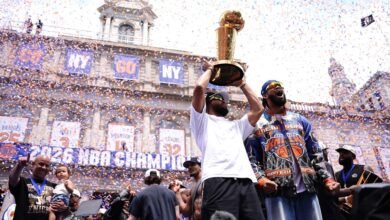
Whether Dolan or Rose deserves more credit for the move is unclear, but the owner has publicly staked his reputation on the strategy, telling WFAN’s Craig Carton in January that “we want to get to the Finals and we should win the Finals.” The decision to replace Thibodeau now looks like a stroke of genius. Not simply because this week the Knicks return to the NBA Finals for the first time in 27 years but because it could provide some level of vindication to Dolan, long one of the most vilified team owners in professional sports. The Knicks’ success comes at a particular low point for several New York franchises with the Jets and Giants coming off dismal seasons, the Mets struggling once again, and the Yankees’ last ticker-tape parade way back in 2009. “One might argue that right now, today, the best owner in New York City: Jim Dolan,” Carton recently declared.
One might. Plenty of others might not. Yes, the team’s magical run is earning Dolan, 71, some warmer words from critics and long-suffering fans. In 2020, Spike Lee accused Dolan of “harassing” him after security guards impeded the director’s regular use of an employee entrance at the Garden. “The Knicks are the laughingstock of the league,” Lee said amid the public spat. Now Lee gives Dolan credit for hiring Brown, Rose, and special adviser William Wesley — better known as “World Wide Wes” — to engineer this moment. “It’s all orange-and-blue skies,” Lee tells me. “Me and Mr. Dolan are Kool & the Gang.”
But Dolan’s history of vindictive and petty behavior is wide and deep — and not all fences have been mended. While Charles Oakley has gushed about the team dominating in the playoffs, and has attended games on the road, he apparently hasn’t been to the Garden since 2017, when Dolan had security remove the ’90s Knicks great from the stands, claiming he had been belligerent. Oakley was handcuffed and charged with assault, an accusation that was eventually dismissed. Dolan then used a radio interview to suggest Oakley might have been drunk. The two have been wrangling in civil court ever since. Oakley recently called Dolan “a bully” who is “running a plantation,” and has said he will not be at game three on Monday at the Garden. Oakley did not respond to a request for comment, though a staffer at the car wash he owns in Yonkers laughed and said, “We’re not talking about the Finals, not after how bad the Knicks have treated him.”
Mayor and Knicks die-hard Zohran Mamdani has expressed a willingness to broker peace between Dolan and Oakley, telling Pablo Torre on Tuesday, “I can’t make a promise now that I’m not sure if I can keep, but I will try because I think that this moment is for the whole city. And it’s a moment where people are willing to look forward after a long time for us just looking in the rearview mirror.”
Beyond the Oakley episode, Dolan has come under fire for the Garden’s sophisticated facial-recognition apparatus, a system that was detailed in a recent Wired feature story. A lawsuit alleges that the Garden spent two years tracking, in extreme detail, the movements of a transgender Knicks fan out of concern that her presence could somehow embarrass the organization. (MSG Entertainment didn’t specifically comment to Wired’s reporting about Dolan and the activities of his security team, but said its story was “built on false, misleading and unverified allegations.”) The Garden has also used the tracking systems to ban dozens of lawyers involved in lawsuits against the company. That includes some lawyers representing clients in personal-injury suits against the company.
Other bans combine the comical with the intimidating. In 2017, after the Oakley altercation, Frank Miller Jr., a graphic designer, created a “Ban Dolan” T-shirt. Eight years later, Miller was standing on line with his parents for a Cleo Sol show at Radio City Music Hall, also owned by Dolan, when security guards pulled him aside and said his name was on a blacklist. “I guess you could still be a Knicks fan,” Miller tells me, “even though the owner of the team is a petulant child.” The MSG communications department did not reply to a list of questions. In the past, the company has said its use of technology is intended “to provide a safe and wonderful experience for our guests.”
When Brad Hoylman-Sigal was a state senator, he pursued legislation — unsuccessfully — to rein in the surveillance and a budget change to repeal the Garden’s long-standing property-tax exemption, which has saved the company an estimated $1 billion. Hoylman-Sigal, now the Manhattan borough president, was once warned that Dolan might have hired a private investigator to tail him. “The Knicks are winning, so he’s doing something right,” Hoylman-Sigal says. “On the other hand, Dolan is the New Yorker everyone loves to hate.”
Charles Dolan was a cable-television pioneer, building Cablevision from 1,500 to more than 3 million subscribers. James, the first of Charles’s six children, grew up on Long Island, and he was an outlier in the buttoned-down Dolan family: a blustery personality whose first love was rock music. Things settled down somewhat after James spent time at Hazelden to deal with drug and alcohol problems, and in 1995, Dad made him CEO of Cablevision. “Mostly, it was because no one else wanted it,” Charles Dolan was quoted as saying by this magazine in 2005. (Two years earlier, Dolan was briefly part of a group including Jeffrey Epstein, Harvey Weinstein, and Mort Zuckerman that attempted to buy New York.)
That James Dolan cared about sports came in handy, given that Cablevision was in the process of buying Madison Square Garden and its properties, among them the Knicks, the Rangers, and the MSG network. On the business side, James’s reign has been, on balance, highly successful. In 2016, he sold the cable business to the European telecom giant Altice for $17.7 billion. He retained control of Cablevision’s sports and entertainment empire, which had expanded to include Radio City and the Beacon Theatre.
Most recently, in 2023, Dolan opened the Sphere, a massive immersive performance hall in Las Vegas. While the Knicks and Rangers are “near and dear to my heart,” he told the Times as the Sphere took shape, “I don’t really like owning teams.” Dolan’s focus on building the Sphere may have bought the Knicks organization some space to stabilize under the guidance of Wesley and Rose. “Dolan tried handing over more control by hiring Phil Jackson in 2014, but he had the wrong guy,” says Chris Herring, who covered the NBA for ESPN and wrote a book about the ferocious near-champ 1990s Knicks. “He deserves credit for getting it right this time.”
The entertainment venues have been hits. Dolan’s stewardship of his sports teams has been a whole lot rockier. The Rangers last won the Stanley Cup in 1994, before the Dolans were fully in charge. Since then, the team has swerved between contending and incompetence. In 2021, just as a rebuilding effort was gaining traction, Dolan suddenly fired John Davidson, a former Rangers goaltender and broadcaster who had become team president. “I wasn’t very happy,” Davidson says. “But he’s the boss. Yeah, he pushes you, but he gives you every opportunity to win. It was a fantastic experience. When we had our chat about me not working there, he said, ‘J.D., you’ll always be a Ranger.’ That meant a lot.”
Davidson and others also point to Dolan’s many charitable endeavors. The Garden of Dreams Foundation provides money and assistance to more than 250,000 children. Benefit concerts after 9/11, Hurricane Katrina, and Superstorm Sandy raised nearly $100 million, and he has underwritten pancreatic-cancer research in honor of a Garden executive killed by the disease. Dolan has loyal aides who have been with the Garden for many years. Still, some former employees say he sets the tone for a difficult day-to-day atmosphere. “It’s a tough place to work — a grueling, whipcracking environment,” one former staff says. “There’s a culture of fear because he’s fired a lot of people. But the caricature of Dolan as some bumbling idiot is wrong. He’s very savvy.”
No example is more prominent than the Garden’s location. Through four decades, five mayors, and five governors, Dolan has beaten back pressure to move the building, which would enable the overhaul of Penn Station, the decaying mess of a transit hub that sits directly below the arena. Some of that intransigence has been maintained through traditional means: Dolan and MSG have constructed a skilled lobbying team in Albany and spread campaign contributions around.
Dolan has also used more muscular tactics to get what he wants. Three years ago, when the State Liquor Authority warned that the Garden could lose its alcohol license if it used surveillance to ban customers, Dolan went on Fox 5 and threatened to shut down alcohol sales for one night at a Rangers game, displaying a photo and phone number of the state official he said was to blame. Last year, Dolan poured money into the long-shot candidacy of an opponent to Manhattan district attorney Alvin Bragg, who had apparently angered him by asking questions about the Garden’s surveillance methods. “His politics are very personal and vendetta-driven, not policy-oriented,” one government insider told me.
So, too, are Dolan’s relations with much of the media. Aside from occasional appearances on Fox and WFAN, he rarely gives interviews; the Garden’s media-relations department did not respond to a request to talk with Dolan for this story. Some of his spontaneous interactions with reporters have been tense. Wallace Matthews was a sports columnist at the New York Post when he ran into Dolan at the Nassau Coliseum after a Rangers-Islanders game. “I had never met him before, and I walked over with my hand out and said, ‘Mr. Dolan? I’m Wallace Matthews,’” he recalls. “He pulled his hand back and said, ‘You’re a bad guy. Get the fuck away from me.’”
The style is similar to that of another autocratic Manhattan mogul. Dolan and President Donald Trump go way back. Dolan’s second wedding, in 2002, took place at Mar-a-Lago, and he contributed to Trump’s 2016 and 2020 campaigns. In April, Dolan went to the White House, along with real-estate developer Steve Roth, to discuss Penn Station, and in May, Transportation Secretary Sean Duffy announced an $8 billion renovation that would leave the Garden in place — while possibly paying Dolan for the right to tear down the adjacent Infosys Theater. “This could be a sweetheart deal for not just the developer but for the Garden,” Hoylman-Sigal says. “Trump has put his gold-plated thumb on the scales of this project.”
The president may soon be putting himself into one of the Garden’s suites. Trump has said that Dolan invited him to attend one of the Knicks’ Finals games — which in some ways would be perfect. Just as Dolan is on the verge of earning himself enormous goodwill, he could be thumbing his nose at New York by hosting an appearance from one of the few people the city loathes even more. Or maybe, if the Knicks win it all, nothing else will matter. “My guess is that I don’t exactly share James Dolan’s politics,” says Howard Wolfson, a Democratic strategist turned top adviser to Michael Bloomberg and a die-hard Knicks fan. “But all things are forgivable if they win.”