
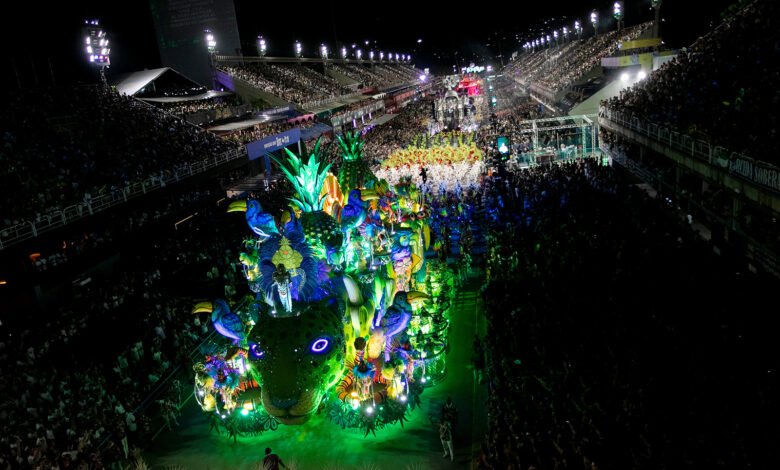
(RNS) — Rio de Janeiro’s lavish Carnival parades, which burst to life in the days before Lent begins, are famous for their colorful costumes, giant floats and the driving rhythm of samba that is a hallmark of Brazilian culture and a magnet for tourists from around the globe. Each parade is produced by one of Rio’s samba schools, which work year-round to prepare them, and each has its own “plot” — enredo in Brazilian Portuguese — that guides its aesthetic. Themes range from tributes to historical figures or artists to pop culture to social and political critique.
These parades all compete on craftsmanship, choreography, rhythmic precision, narrative coherence and the poetic quality of their original song lyrics. They are broadcast nationwide and make headlines around the world.
What is less known about the samba communities behind the parades is their Afro-Catholic religiosity — Afro-Brazilian spirituality that coexists with popular Catholicism: Each school has an orixá — an African deity and a catholic saint of devotion — and at the altars found in the rehearsal halls, the schools’ spiritual guides perform rituals and Masses.
“They are recreational organizations, but religion is present in their social life throughout the year,” said Lucas Bártolo, anthropologist and author of a study titled, “On the Altar of Samba: Religion in the World of Carnival.” “Both the worship of orixás and the devotion to Catholic saints organize the religious life of carnival groups and ground their symbolic dimension.”
In Brazil, as in other Latin American countries, the Catholicism of the Iberian Peninsula arrived with colonization. The church maintained strong links with the state, setting dates and festivals that structured the calendar. Carnival begins the Saturday before Ash Wednesday and ends on Shrove Tuesday, also known as Fat Tuesday, or Mardi Gras, before Lent’s 40 days of fasting start.
“It is a festive period, deeply religious, representing an opposition between Carnival and Lent, which is very strong in Iberian culture, and has also been appropriated by African-derived groups,” Bártolo said.

Afro-Brazilian religions have interacted with Catholicism and Christian festivals since the Portuguese arrived, reinterpreting the colonial religion through their own practices and worldviews, even observing aspects of Lent.
“The origins of Carnival in Brazil are linked to enslaved Africans who were brought here and came together to create samba using percussion instruments,” Aydano André Motta, journalist, screenwriter, writer and Carnival researcher, told Religion News Service. “Samba gave rise to samba schools as community spaces in the neighborhoods where these people settled after abolition — predominantly low-income communities, known as favelas.
“Every samba school has always included a priest or priestess from Candomblé or Umbanda,” Motta added, referring to two dominant Afro-Brazilian religions. “The social dynamics of samba schools are guided by (their) rituals.”
Before official parade competitions began in the 1930s, and before state authorities, the media, wealthy classes, corporate sponsors and tourists became involved, the samba schools were confined mostly to homes in the Afro-Brazilian community.
The rhythms of Carnival are derived from the drumming that is central to communication and spirit invocation in Africa. “The instruments used in ritual spaces are the same as those in the school’s percussion section,” said Carlos Monteiro, a journalist and sociologist from the Federal Fluminense University.
Samba brought together the descendants and the percussion of Africans with distinct languages and cultures. “What the diaspora separated, cultural diasporic practice united,” Monteiro said.

Of the two main branches of Afro-Brazilian traditions, Candomblé focuses on orixás, while Umbanda is more given to blending Catholic and Indigenous spirituality, religious mixing that emerged when, under slavery, African practices were forbidden. The orixás each have Catholic equivalents: “Oxum is syncretized with Our Lady of Conception, Oxóssi with Saint Sebastian, Xangô with Saint Peter, and more than any other, Ogum with Saint George. Ogum is the orixá of war and metals, and Saint George is the most popular saint in Rio, and therefore in the samba schools,” said Motta.
The Catholic Church’s relationship with Carnival and samba schools has historically involved periods of “absolute rejection and condemnation of public discourse, including attempts to prohibit and criminalize these practices,” according to Bártolo. In Rio, city laws were proposed to restrict or regulate Catholic symbols in parades, claiming they profaned sacred images, and schools have often had to modify images of Mary and other Catholic saints to avoid clashes with religious authorities.
In 1989, when a samba school called Beija-Flor planned to depict Christ as a beggar, the church prevailed, but the float entered the Sambadrome — the stadium built for viewing the parades — covered in black trash bags with a banner reading, “Even forbidden, look upon us.”
The opposition has a racial element, given that samba schools have always been predominantly Black institutions. At times, this opposition takes theological form, particularly in the demonization of Afro-Brazilian deities. Exú, a central figure in Candomblé and Umbanda, is a messenger between the human and divine worlds and has long been associated with the devil by Christian groups. But Afro-Brazilian religions, which don’t have a concept of absolute evil, see Exú as playful.
Although African-derived religiosity has been embedded in samba schools since their origins, it was only in the 1960s that they began to explicitly incorporate Black Brazilian culture into their plots. “From there, numerous parade themes highlighted Black history and figures who had previously been invisible in Brazil’s official history,” Motta said.

Under Dom Orani Tempesta, archbishop of Rio de Janeiro since 2009, and with the election of Pope Francis, the Argentine bishop who championed the Amazon and its culture, the church came to support Catholic-themed parade narratives. “Today, it is common for Masses to be held at samba school headquarters, for Carnival groups to be received in sanctuaries and for their flags to be blessed in churches,” Bártolo said, though he added that the rapprochment still has its limits.
The growth of evangelical Christianity in Brazil since the 1980s has added a new dimension to the religious disputes over Carnival. Initially, evangelicals avoided the celebrations, organizing spiritual retreats during this period. Later, as they became more publicly active and aligned with conservative Catholics in criticizing Carnival, they drew political and social criticism from samba schools, while framing themselves as victims of religious persecution.
When Rio elected Marcelo Crivella, bishop of the Universal Church of the Kingdom of God, mayor in 2017, “he tried, very hard, to destroy samba schools and Carnival,” Motta said.
The debate intensified recently when Pastor Gil, an evangelical Rio de Janeiro legislator, proposed a bill that would ban the use of sacred images or representations deemed disrespectful to Christian, Catholic or Evangelical faith in Carnival parades and events.
Still, Carnival has served as a space for coexistence of Brazil’s wildly divergent social, racial and cultural differences, allowing marginalized groups to gain legitimacy as they express their culture. In recent years, the parades have emphasized Afro-Brazilian religions, as if to say, Bártolo said, “This is religion, too, not just Afro culture or Brazilian culture.”
“The people of samba schools are experts in resistance,” said Motta. “They survived slavery, structural racism, state violence and state repression. The schools survived and will continue surviving.”
Source link