
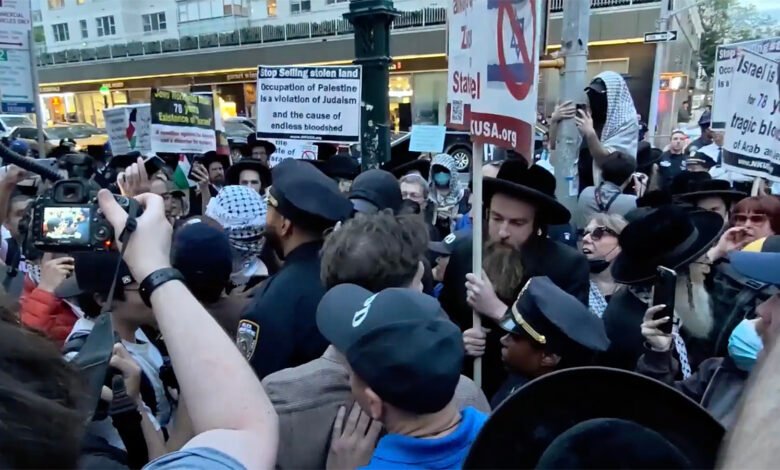
(RNS) — The Torah reminds us that societies rise or fall based on the systems they have built and whether those systems work to preserve order, safety, security and communal trust. This speaks powerfully to a complicated issue facing New Yorkers at this moment — the debate around buffer zone legislation near schools and houses of worship.
While the bill establishing buffer zones around houses of worship passed with a veto-proof majority, on April 24, Mayor Zohran Mamdani vetoed the complementary bill establishing buffer zones around educational institutions. Concerns about the right to protest are real, and a democratic society must fiercely protect the right to assemble, to disagree and to protest.
So, too, does Judaism revere free speech as essential to a healthy society. Abraham, Noah and Moses all argued with G-d when they feared his wrath was too severe or unjust. Jewish history is filled with dissenters who spoke truth to power.
But Judaism also teaches that rights exist within moral boundaries. While it fiercely protects intellectual dissent and debate, it thoughtfully restricts speech that causes social, emotional or religious harm. The right to protest is markedly different from the right to intimidate those who wish to enter a synagogue, school or community institution. A society has an obligation to preserve not only liberty, but also basic human access to communal life without harassment, fear or violence.
This is precisely what buffer zones attempt to do. A buffer zone does not prohibit protest. It does not silence disagreement. It does not erase political expression. People may still march, chant, hold signs, organize and advocate. Establishing buffer zones thoughtfully delineates the boundary between protest and direct obstruction or intimidation at the threshold of vulnerable communal spaces. That, fundamentally, is a Jewish idea.
The Torah constantly creates sacred boundaries. There are boundaries around the Mishkan (Tabernacle); Mount Sinai; protecting the poor, the blind, the orphan and the stranger. Boundaries exist around labor practices. And, yes, there are boundaries around speech. Judaism understands that freedom without boundaries devolves into domination by the loudest and strongest.
In our time, many Jews walk toward synagogues, schools, community centers and Holocaust museums feeling anxious about harassment, confrontation, intimidation and physical assault at the entrance. This has been observed countless times, including just a couple weeks ago outside of Park East Synagogue in Manhattan. Even with police enforcing a buffer zone, the protest turned violent, with demonstrators storming the barricades and assaulting police officers. In fact, the Anti-Defamation League recently reported that there are an average of 17 antisemitic incidents in the United States each day.
The ability of a child to walk safely into school comes before another person’s desire to confront them at the doorway. The ability of a congregant to enter a synagogue peacefully comes before another person’s desire to demonstrate feet from the entrance with the sound of derogatory chants permeating the walls of a sanctuary as they pray. The right of a community to gather without harassment supersedes one’s right to access every single physical space for protest activity.
This does not negate civil liberties. Rather, it balances them. The Torah asks us not only whether something is permitted, but also whether it preserves human dignity. This hierarchy matters.
Judaism rejects the notion that every value exists in isolation. Pikuach nefesh — protecting life — overrides nearly every other commandment. Human dignity can supersede many rabbinic prohibitions. Our tradition is built on prioritization, which is the foundation for many modern rabbinical rulings. The Torah does not imagine freedom as absolute individual license. Instead, Judaism constantly asks: Whose vulnerability takes precedence? Which obligations come before which freedoms? When rights collide, what must society protect first?
The Book of Leviticus — particularly Chapters 19 and 25, which are regarded as the “Holiness Code” — is deeply concerned with freedom, dignity, responsibility and the structural foundations necessary for a moral society. At first glance, it appears as a mere collection of laws. But underneath all of the particular intricacies of observing these mitzvot, or commandments, lies a profound Jewish idea: Not all rights exist on the same level.
As G-d states in Leviticus 25:23, “The land is Mine; you are but strangers and settlers with Me.” Human beings are merely stewards of the land. While property rights matter, the dignity of the poor matters more. While economic freedom matters, preventing exploitation of laborers matters more. Though debt collection is permitted, all debts must eventually be forgiven. Time and again, the Torah establishes limits around power to protect human dignity. A holy society requires moral hierarchy, and holiness emerges from freedoms being tempered by our responsibilities toward one another.
In a polarized age, we must resist simplistic thinking. While the right to protest is essential to democracy, it is not absolute. Our legal system has always recognized reasonable “time, place and manner” restrictions on speech. These limits do not eliminate free speech — they ensure that other fundamental rights are protected.
Legitimate fears about government overreach and restrictions on protest deserve serious consideration, not dismissal. But we should also recognize that protecting access to schools and houses of worship is not censorship. It is an affirmation that communal safety and human dignity are foundational obligations of a just society.
The Torah calls us not merely to defend rights, but to order them wisely. And when we do, we build not only a freer society, but a holier one. Let us hope that those in power heed this lesson.
(Olivia Brodsky is the cantor and co-clergy of East End Temple in Manhattan. The views expressed in this commentary do not necessarily reflect those of Religion News Service.)
Source link