
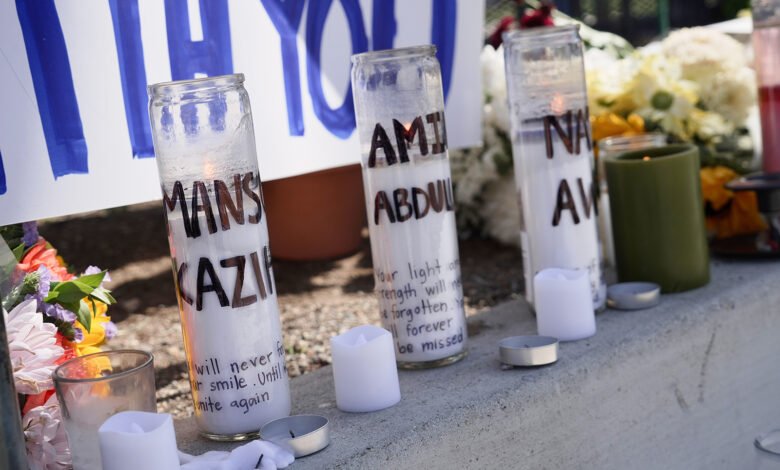
(RNS) — This week, Muslims around the world are celebrating Eid al-Adha, a sacred holiday rooted in sacrifice — the willingness to give what is most precious in service of faith and love. On May 18 at the Islamic Center of San Diego, three Muslim men embodied that devotion when they gave their lives to protect children and their community. A security guard and congregants of the mosque chose courage in the face of violence and saved many lives. But the community that calls this mosque home is grieving the loss of its members’ safety, their sanctuary and three beloved lives taken from them at the hands of two teenagers.
This shooting was not just an attack on a sacred space — it was an attack on the very idea that all of us, across our differences, deserve to live in safety and dignity. As a Muslim, as a mother and as someone who has spent my life building bridges across lines of faith and identity, I felt the news like a blow to the chest. The grief is real. The fear is real. But so is our resolve.
What happened in San Diego is not a new phenomenon. It is part of a pattern we have seen again and again. We can no longer ignore this pattern. Houses of worship — mosques, synagogues, churches, gurdwaras, temples — have become targets for people who believe violence can erase the presence of those they see as the “other.” These attacks are meant to intimidate, to fracture, to make us retreat into ourselves. They rely on the lie that we are safer apart.
We cannot ignore the national climate that fuels this violence. When bigotry is echoed from the White House and amplified by senior Republican leaders — when Muslims, immigrants and communities of color are cast as threats — it gives hate the permission to evolve into acts of violence. It claims the humanity of entire communities, turning them into caricatures of “the other.” This rhetoric does not stay contained to press conferences or social media feeds. It spills into our neighborhoods, our schools and, as we saw last week, our sacred spaces.
We must also grapple with another heart-shattering truth: Hatred does not form in a vacuum. The shooters were teenagers — children, really — who had been shaped by a steady diet of fear and resentment, taught to see people different from them as enemies. No young person arrives at that level of hatred on their own. When we allow bigotry to go unchallenged, when we let isolation replace community, when we fail to teach our children how to live with difference, we create the conditions in which hate can take root in their hearts and manifest in their actions. Their actions caused profound harm, and they must be held accountable — but we must also reckon with a society that teaches young people to turn isolation, grievance and bigotry into violence.
We are strongest when we choose each other. We are strongest when we fundamentally believe we belong to each other.

Imam Taha Hassane, center, embraces another person as they attend a vigil, the day after a shooting, outside of the Islamic Center of San Diego, May 19, 2026, in San Diego. (AP Photo/Jae C. Hong)
I am reminded of the people who chose to further commit to their values when faced with these horrific circumstances. I think of the Sikh community in Oak Creek, Wisconsin, who continued to cook for and feed hundreds of people who showed up to help them. I think of the Jewish community in Pittsburgh, which met antisemitic violence with solidarity and a renewed commitment to welcoming the stranger. I think of the families and survivors in Charleston, South Carolina, who turned grief into a national witness against racism and a profound example of forgiveness.
These are not merely small gestures of hospitality. They are grand acts of moral imagination. They remind us that our communities are intertwined, that our safety is shared and that our liberation is bound together.
Cooperation across differences is not a feel-good idea. It is a survival strategy.
In the coming days, many will offer thoughts and prayers. Those matter. But what matters more is how we move forward from those thoughts and prayers.
We need elected officials who will unequivocally condemn anti‑Muslim hate and all forms of religious bigotry. We need investments in community‑based safety strategies that do not criminalize marginalized communities. We need educators, clergy and civic leaders who will teach the next generation that pluralism is not a threat — it is a promise. We cannot undo the harm that happened in San Diego. But we can decide again and again to choose what grows from these moments from the aftermath of hate. We can choose courage over silence, connection over isolation and shared humanity over narratives that seek to divide and kill us.
(Jenan Mohajir is vice president of external affairs at Interfaith America, a national nonprofit organization that equips leaders to navigate a pluralistic world. The views expressed in this commentary do not necessarily reflect those of Religion News Service.)
Source link