

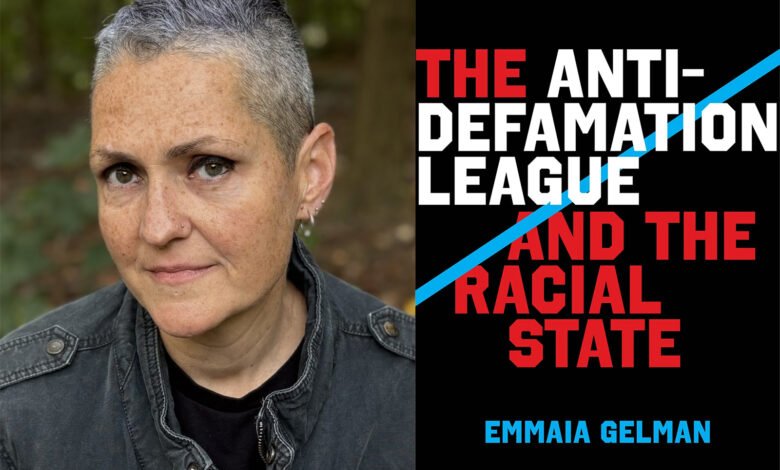
(RNS) — Emmaia Gelman’s new book about the Anti-Defamation League opens with an almost forgotten incident. In 1993, the FBI raided the ADL’s San Francisco offices for “spying on civil rights groups and antiracist organizers.” The New York Times, which covered the incident, noted that the raid “caused confusion for some liberals” who thought the ADL was a paragon of civil rights activism, the book recalls.
As Gelman writes in her critical account, the ADL — a national group founded in 1913 to combat antisemitism and other forms of discrimination — may have appropriated the language of civil rights, but its actions have mostly been in defense of state interests. After the FBI raid, the ADL was accused by San Francisco authorities of spying on civil rights activists and other leftist groups for at least 30 years — allegations the group denied but accepted in a court-ordered settlement.
Gelman’s book, “The Anti-Defamation League and the Racial State,” published Tuesday (June 16) by the University of California Press, seeks to show that the organization was created to defend white Western authority, principally that of the U.S. and later Israel. Insisting Jews were part of that white Western heritage, it set about to promote their assimilation to American values.
In a statement, the ADL said it was proud of its work. “Written by an avowed anti-Israel activist and Hamas apologist, this book should be understood for what it is: A work of historical revisionism in service of a political agenda,” a spokesman said.
As Gelman’s research shows, far from belonging on the left, it may be more accurate to describe the ADL as a Cold War neoconservative institution. While the ADL has fought against the Ku Klux Klan and later neo-Nazis, it has mostly seen the left – and especially those championing Palestinians, Muslims and diverse Arab communities — as a bigger threat, the scholar notes.
Since the Oct. 7, 2023, Hamas attacks on Israel, the ADL has supported a crackdown on student protesters critical of Israel’s war on Palestinians in Gaza. It has opposed the election of New York’s first Muslim mayor, Zohran Mamdani, over his criticism of Israel and created the “Mamdani Monitor” to “protect Jewish residents” after his win. It has worked to appease the Trump administration and argued that what appeared to be a Nazi salute by Elon Musk was just an “awkward gesture.”
A scholar with a doctorate in American studies from New York University, Gelman wrote about the ADL for her dissertation and later added to it for the book. Gelman, who is Jewish, is also an activist. She is the founding director of the Institute for the Critical Study of Zionism, an independent anti-Zionist, anti-racist research institute.
RNS talked with Gelman about the ADL and what she describes as its conservative mission to protect the U.S. and Israel from any criticism and to label anyone who criticizes those states’ policies as antisemitic. The interview was edited for length and clarity.
You write that the ADL was founded by German Jews who had already established themselves in the U.S. as businesspeople committed to capitalist values, and they wanted to correct the behaviors of poor, pro-labor Eastern European Jews. Is that right?
The Anti-Defamation League was formed with this idea of opposing defamation very literally, but what defamation meant was often the portrayal of Eastern European Jewish formations. It first directed at the press to say, ‘Don’t use images of Jews as either dishonest or self-interested money lenders and don’t use the image of Jews as dirty immigrants, fresh off the boat.’ They did a lot of clarifying that actually Jews were part of the upper classes and the governing classes and contributed to nation building, but very quickly they turned to trying to censor Jewish immigrants’ representations of themselves. Within about 15 to 20 years, the ADL had turned to publishing facts and books that articulated that communism was not Jewish, could never be Jewish and was antithetical to Jewishness. So, yes, they absolutely did try to suppress various expressions of Jewish immigrant life and Jewish politics. They were intended to marginalize Eastern European Jewishness and redefine Jewishness as the German Jewish upper-class, pro-state, law-and-order version.
Why did the ADL turn to spying?
The ADL’s stock in trade was books and reports explaining things. It published reports on subversives. So it, for example, started reporting on white nativists, like Father Coughlin (the antisemitic radio broadcaster) and then on what they viewed as Arab subversives. Much of it was presented in this sort of espionage format: So-and-so received mail that said this, and so-and-so said that at a meeting. By the McCarthy era, they already had files on Jewish leftists that they were offering to (Sen. Joseph) McCarthy (who spearheaded a campaign of persecution against Americans suspected of communism).
You write that the ADL began to see the main threat to Jews in the United States coming from the left rather than the right. When did that start to happen?
In its early days it singled out white Christian nativists who were racist and antisemitic in the sense of holding old Christian antisemitic tropes. But the ADL was also anti-communist and anti-left because its whole premise was that U.S. capitalism, the colonization of North America, was a moral project that resonated with European morals. They believed themselves to be very much part of European national culture. The left, which had identified with the Soviet Union, was the primary threat there, and so the ADL took up anti-communism as its main gig. At that point, it was so focused on producing citizens who were loyal to the United States, and colorblind and devoted to individualism and individual rights, that it actually considered ending its identification as a Jewish organization and just acknowledging that as its main project. Irwin Suall, who joined in 1967 (and headed the ADL’s undercover investigations) reflected the new turn on the entire left — the anti-war movement, the Black Power movement, the Jewish left, anti-war protests, etc.
The ADL was critical in developing legislation on hate crimes. How did it land on that?
Throughout the early ’80s, the ADL and some other legislators had been trying to pass laws that added penalties for acts of religious vandalism that were already crimes. So, for example, if somebody broke the windows of a synagogue, there would be an extra penalty because it’s a synagogue, and it’s targeting a religious property. This was a response to the feeling that many conservatives had in regard to counterculture, that there was a loss of respect for things like religion and tradition.
In the late ’70s, early ’80s, a separate crisis arose of violence against people of color and immigrants and also anti-queer violence. President Reagan’s Department of Justice was refusing to intervene, saying it didn’t fall under their jurisdiction because it wasn’t a civil rights violation. Local police weren’t intervening, either. While the ADL hadn’t been able to galvanize public support for religious vandalism laws, there was public support for racially coded crimes. And so, the ADL was able to move into that space and combine the two things. So, in its 1981 Audit of Antisemitic Incidents, the ADL appended a piece of model legislation that became hate crimes bills. Other states and other community groups took it up as a legislative action cause.
You write that these hate crime bills were a way to mask deeper structural issues.
Absolutely. The function of hate crimes bills was to try and force the state to do something rather than nothing about the immediate racist violence, but what it did actually was allow political legislatures and political figures to simply address the snipers, and not address the broader racial structures of states that were producing them and authorizing them. Police violence is not considered in hate crimes statistics or policy. So you end up with a law that only looks at what has happened between two individuals — the perpetrator and the target — rather than looking at the very extensive racial state system that has produced the conditions of that violence.
How do you see the ADL today? Has it become MAGA?
If going MAGA is very defined as having MAGA pastors as headliners in its antisemitism conferences, and exonerating Elon Musk and removing from its website the tracker of white nationalist organizations that (FBI Director) Kash Patel complained about, sure, the ADL has gone MAGA. But what about its long-running support for repressive policing, for surveillance of Muslim organizations, for whipping up fear that people who oppose capitalism or who propose ways of organizing our political system other than capitalism are quote-unquote, Soviet and insurgents? Those things have been part of the ADL political fabric for much longer than Trump has been in office. The push to declare all criticism of Israel to be antisemitic is (from) 2016. Even before that, the ADL was targeting Palestinian and Muslim and Jewish student groups who were opposing Zionism on their campuses. It was already doing those things before MAGA was a thing. In 2019, the ADL began leading the charge against ethnic studies programs on the basis that it was essentially critical race theory. It was doing those things long before, and we didn’t recognize them broadly as right-wing constructions.
Has its power waned?
The FBI broke with the ADL formally, so the ADL is no longer doing FBI training. But it’s not banished from the other spaces where it has worked. It is still treated as an anti-racist organization in schools and it’s brought in when there’s a racist incident or an antisemitic incident.
Its power is an interesting one because the ADL is not a membership organization. Partly its power comes from its ability to rely on megadonors who are deeply conservative and right wing, and who are seeing the way that the ADL is able to move in ostensibly liberal spaces is a unique weapon. It also gets its power from the press who continually publish its statistics and its claims about antisemitism with no scrutiny and no attention to the ADL’s broader political project. The fact that so many of us oppose it has not actually diminished its power in the way that it should have if the ADL were in any way grounded in community.
Source link