

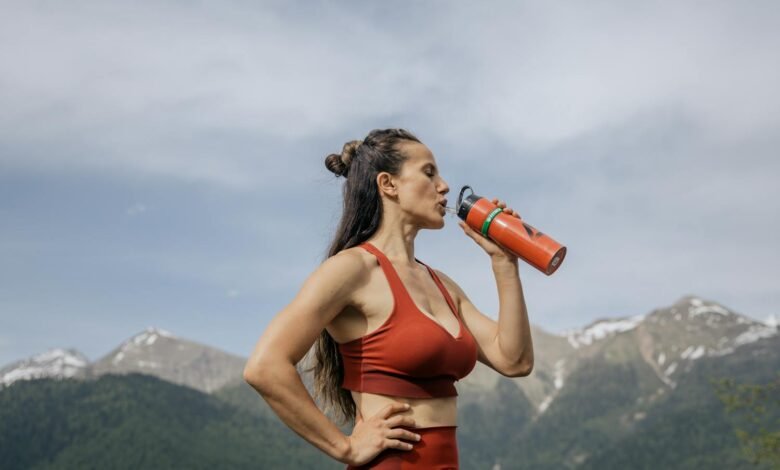
A cheap water bottle looks like a $5 problem and turns into a $50 one. The bottle you grabbed at the airport or pulled off an Amazon bestseller list rarely lasts more than a year of real use. The valve goes soft, the cap starts dripping, the inside gets cloudy, and the water starts tasting like the bottle. A year later you replace it, and the cycle starts over. This piece walks through what those bottles really cost you over time, and what to put in your bottle cage or running vest instead.
The real math on a $5 bottle
Most athletes have lived this. You buy a generic squeeze bottle at a checkout counter, use it for a few months, and one day you notice the water tastes wrong. The lid leaks if you do not crank it down. The bite valve has a permanent groove from your teeth. You toss it and grab the next one, because $5 felt like nothing.
Run the math at the household level and the picture changes. Two bottles per person, replaced roughly every six months, runs about $20 a year per athlete. Over five years that is $100, and you have put ten bottles in the trash to get there. A single quality bottle in the $25 to $45 range, treated reasonably, often runs the same five years on a single frame. The dollars are similar. The waste is not, and the on-bike or on-trail performance from a cheap bottle is rarely close.
There is also a quieter cost that does not show up on the receipt. A bottle with a failing valve trains you to drink less on long rides, because pulling the bottle out of the cage no longer rewards you with water, and a bottle that tastes bad does roughly the same thing. Hydration drops a little on every ride, and that catches up to you on the second half of any long session.
“A bottle with a failing valve trains you to drink less on long rides. Hydration drops a little on every ride, and that catches up to you on the second half of any long session.”
Durability and replacement frequency
The published guidance on cheap reusable plastic bottles is roughly six to twelve months before replacement. Polycarbonate runs one to two years, Tritan runs one to three, and stainless steel can run a decade with care. Those numbers are not arbitrary. They map to how long the polymer keeps its structural integrity before microcracks open up, how long a soft valve keeps its seal, and how long a thread cap stays squared in its body.
What that looks like in practice is a slow accumulation of small failures. There is the hairline crack near the cap thread that you only notice when the bottle leaves a wet ring on your floor, the bite valve that no longer closes flush so the bottle drips inside your jersey pocket on a descent, and the faint plastic smell that survives a hot wash. None of these are dramatic on their own, but together they push the bottle to the trash within a year.
The bigger toll of replacing five to ten bottles in five years is not really financial. You spend that whole stretch riding or running with bottles in various states of failure, because a cheap bottle is rarely at peak performance. By month four it is already partway through its decline.
Plastic taste and chemical leaching
When water starts to taste like the bottle, a couple of things are usually happening. The polymer is shedding small amounts of additive into the liquid, and the inside surface of the bottle has built up a film that holds residual flavor from previous fills. Hot dishwasher cycles accelerate both. One peer-reviewed study found more than 3,500 different compounds in water from a soft plastic bottle after a single dishwasher cycle, with many of them traceable to dishwasher detergent residue and to plasticizers softened by heat.
The names worth knowing are bisphenol A and bisphenol S. BPA was added to the California Proposition 65 list in May 2015 as a reproductive toxicant, and warnings became required on consumer products in May 2016. It was added again as a developmental toxicant in 2020. BPS, the most common BPA replacement, was added to the same Prop 65 list in December 2023, also as a reproductive toxicant. Both behave as endocrine disruptors. Most modern sport bottles are now labeled BPA and BPS free, but cheap unlabeled bottles, especially ones with no brand on the body, often have no information at all about what they are made of.
The taste is the early warning. By the time the bottle reliably makes water taste musty or metallic, the polymer has already been giving something up to your drink for a while.
Safer plastics for reusable water bottles:
- HDPE (#2): inherently BPA free, resists leaching during normal use
- LDPE (#4): used in quality squeeze bottles, BPA free
- Polypropylene (#5): BPA free, heat resistant, used in CamelBak Podium
- Tritan: BPA, BPS, and phthalate free per manufacturer Eastman
- Stainless steel: no polymer contact with liquid at all
Valve failure and mouthpiece wear
The valve is the single most common reason a sport bottle gets thrown away while the bottle body is still fine. Cheap bite valves are made from soft silicone or TPE that wears at the bite point. Riders close their teeth on the valve repeatedly through the season, and the seal eventually goes slack. Once that happens, the bottle drips when it is upside down in the cage on rough roads, and you taste warm water instead of cold the second half of the ride.
Self-sealing valves on cheap bottles fail in a different way. The internal slit that opens under pressure stops snapping closed once the silicone has lost its elasticity, so you squeeze, water flows, and then water keeps flowing in a slow leak after you stop pressing the bottle.
Trail running soft flasks have their own version of this. The small silicone bite ring under the cap can split, slide out of position, or go missing entirely after a wash. Once it is gone, the flask leaks under any compression, which is most of what a soft flask does in a vest pocket.
Higher-end brands sell replacement valves and caps as separate parts. Cheap brands do not, because the bottle was never designed for repair. When the valve fails, the bottle is done.
Cap threads and leaking caps
The threads on a sport bottle cap take more force than people give them credit for. Each time you tighten the cap to stop a slosh leak, you load the threads. On cheap bottles, those threads are molded from a soft, flexible plastic that wrinkles and strips under repeated torque. The same thing happens inside the cap itself, where the inner liner that compresses against the bottle lip can wrinkle or deform after 200 to 300 cycles.
Once a thread strips, the cap no longer seats square. You will notice it as a slow drip when the bottle is on its side, or as a sudden gusher when you bump the bottle in a backpack. People often blame themselves and over-tighten further, which finishes off the threads completely. From there, the bottle is unusable and headed to the trash.
Quality bottles solve this with thicker thread profiles, harder cap plastics, or, in the case of stainless steel, machined threads. They also tend to use replaceable caps. If the cap on a Polar Bottle, a CamelBak Podium, or a Specialized Purist gets worn, you replace the cap and keep the bottle. The Feed and similar specialty retailers stock those replacement parts because the brands sell them.
UV, heat, and the cloudy bottle
Anyone who has left a bottle in a parked car has watched the next stage of bottle decline. Heat and UV light accelerate the breakdown of plastic at the molecular level. PET is sensitive to UV at elevated temperatures and humidity, which is the exact climate inside a car in summer. Polycarbonate and older Tritan develop microscopic surface pitting after repeated exposure to UV, dishwasher heat, and acidic drink mixes like electrolyte powders that lean on citric acid.
The cloudiness people see on the inside of a year-old bottle has a few sources. Hard water leaves chalky calcium and magnesium deposits. Detergent and drink mix can leave a film. And the polymer itself starts to lose its smooth inner surface, which holds biofilm and increases the surface area available for further leaching. Within hours, biofilm bacteria like Pseudomonas, Staphylococcus, and Acinetobacter can adhere to a moist plastic surface, and once microcracks form they protect that biofilm from regular cleaning.
A cloudy bottle is at the end of its useful life, even if it is not leaking. The polymer has changed, and the water sitting in it now is in contact with more degraded plastic surface than it was when the bottle was new.
The environmental cost of the throwaway cycle
The waste pattern around water bottles is bigger than most riders think. US plastic water bottle sales went from roughly 3 billion bottles in 1997 to 86 billion in 2021, per Beyond Plastics. About 23% of those get recycled, and the rest head to landfill or out into the environment. The OECD has reported, via NRDC, that 91% of plastic globally is never recycled at all. Around 8 million metric tons of plastic enter the ocean each year. EPA’s 2018 figures put US plastics generation at 35.7 million tons, with containers and packaging plastic alone above 14.5 million tons.
A reusable bottle is supposed to cut into that pattern. When the reusable bottle gets binned every six months, it becomes part of the same flow. A cyclist who replaces two cheap bottles a year is putting ten bottles into the waste stream over five years. A rider with one well-built bottle from the same period is putting in zero.
Stainless steel and high-quality plastic bottles flip the math. They keep their seals, accept replacement caps, and stay in service long enough that the front-end material cost gets amortized over hundreds of rides instead of dozens. If you are thinking about the environmental impact of your broader gear choices, the same logic applies to reducing toxins in your daily routine and the products you bring into your home.
Where to find quality water bottles outside the big-box aisle
Most general retailers carry one or two mass-market bottle brands at any given time, with the cheapest options stocked deepest. The bottles that endurance athletes rate highly, including Hydrapak soft flasks, Salomon trail flasks, BiVo stainless steel cycling bottles, and Polar Bottle insulated squeeze bottles, are rarely on those shelves. They live with specialty endurance retailers.
The Feed is one of the specialty retailers in that category. Their bottle inventory carries Hydrapak, Salomon, BiVo, and Polar Bottle alongside the standard cycling-specific picks. The selection is built around the way endurance athletes really use bottles, which is in cages on long rides, in vest pockets on trail runs, and in hands during gym sessions and travel days. Big-box stores tend to optimize for impulse buys, which is a different stocking problem than supplying a rider who knows what they want and needs replacement caps and parts down the line.
See also
There are other specialty bike shops and run stores that carry similar inventory. The point is less about any single retailer and more about where these brands live. They are not on the front aisle of a supermarket. If you travel frequently for races or training blocks, knowing where to source quality gear on the road is part of staying fit and well-equipped while traveling.
Recommendations by use case
For road and gravel cyclists who want an insulated squeeze bottle, the Polar Bottle Sport Insulated is the long-running benchmark. It is made in Boulder, Colorado, in LDPE #4 plastic, with triple-wall insulation and a removable rubber valve that comes apart for cleaning. The Specialized Purist sits in the same category with a different approach. Its inner wall is treated with a 20-nanometer silicon dioxide coating that resists stains and odors and keeps the water tasting closer to neutral on hot days. The CamelBak Podium Chill rounds out that group, with a TruTaste polypropylene body, double-wall insulation, and a self-sealing Jet Valve cap. All of these bottles accept replacement caps, which is the part that usually fails first.
For riders who would rather get out of plastic entirely, the Bivo Trio is the standout. It is double-wall vacuum insulated stainless steel, designed in Vermont, with a high-flow gravity-fed nozzle that does not need a squeeze. Cold drinks stay cold for twelve-plus hours. The Feed carries Bivo for cyclists who want a bottle that will likely outlast the bike.
Trail runners and ultra runners use soft flasks, where Hydrapak and Salomon dominate. The Hydrapak UltraFlask shrinks as you drink to reduce sloshing, with a bite valve and a wide-port cap. The Salomon Soft Flask uses a 42mm cap with a high-flow valve and an anatomical tilt that fits flat against the chest in a vest pocket. Both are stocked through specialty retailers like The Feed.
For desk, gym, and travel use, the Klean Kanteen TKWide is hard to beat. It is 18/8 stainless steel with double-wall vacuum insulation, swappable caps, and a smooth rounded lip. Cold holds vary from 33 to 145 hours by size. The Nalgene Sustain is the right pick for anyone who wants a wide-mouth plastic bottle they can run through the dishwasher without worry. It is made in Rochester, New York, from Tritan Renew with material derived from 50% recycled plastic waste. For anyone building out a complete set of healthy daily habits, upgrading your hydration setup is one of the simplest and most overlooked places to start.
Best water bottles for athletes by use case:
- Road and gravel cycling: Polar Bottle Sport Insulated, Specialized Purist, CamelBak Podium Chill
- Cycling, stainless steel: Bivo Trio
- Trail and ultra running: Hydrapak UltraFlask, Salomon Soft Flask
- Desk, gym, and travel: Klean Kanteen TKWide, Nalgene Sustain
Frequently asked questions
Are plastic water bottles safe to reuse?
Reusable bottles labeled BPA and BPS free from established brands are generally considered safe for repeated use. Single-use PET bottles, the kind sold filled with spring water, are not designed for reuse and can degrade and leach more readily than a bottle made for repeated cycles. The risk on cheap unbranded reusable bottles is that you do not know what plastic they are made from.
How often should I replace my water bottle?
For cheap reusable plastic, the typical guidance is six to twelve months. Polycarbonate runs one to two years, Tritan runs one to three years, and stainless steel can last a decade or more with normal use. Replace any bottle sooner if it cracks, smells off after a hot wash, or has a damaged mouthpiece.
What is the safest plastic for water bottles?
The safer reusable plastics are HDPE (#2), LDPE (#4), and polypropylene (#5). All of those are inherently BPA free and resist chemical leaching during normal use. Tritan is also widely used in reusable bottles and is BPA, BPS, and phthalate free per its manufacturer Eastman.
Why does my water bottle taste like plastic?
Plastic taste comes from a mix of polymer additives leaching into the water and residual flavors held in a film on the inside of the bottle. Heat from dishwashers, sun exposure, and acidic drink mixes accelerate the process. A persistent plastic taste after a deep wash usually means the bottle is past its useful life.
Can I put my plastic water bottle in the dishwasher?
Only if the manufacturer says it is dishwasher safe. Heat from a dishwasher cycle can deform soft plastic and increase leaching of polymer additives into future drinks. Bottles from Nalgene, Polar Bottle, CamelBak, and most stainless brands are rated dishwasher safe; cheap unlabeled bottles often are not.
Why does my water bottle get cloudy?
Cloudiness usually comes from hard water mineral deposits, detergent and drink mix residue, and degradation of the inside polymer surface from heat and UV. Once cloudiness is permanent and survives a deep clean, the polymer has microcracks that hold biofilm. That bottle is at end of life.
Better Living may earn commissions through affiliate links and may occasionally feature sponsored or partner content. If you make a purchase through our links, we may receive a small commission at no cost to you.