
I make avocado toast most mornings and have a system: ripe avocado, good bread, everything bagel seasoning, a squeeze of lemon. I’ve made it probably two hundred times without incident.
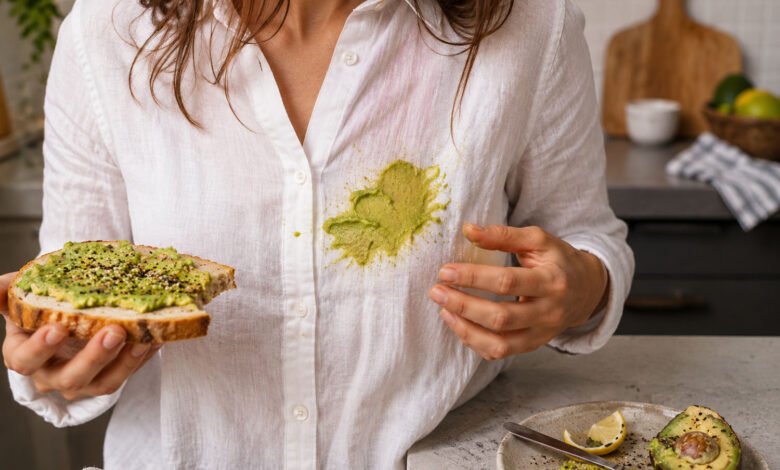
On this particular morning I was running late, which is when systems break down. I was spreading the avocado too fast, the bread slipped, and a solid smear of green landed directly on the front of my white linen shirt. I grabbed the nearest thing, a damp kitchen cloth, and started rubbing at it immediately.
Both of those instincts were wrong.
The rubbing spread the stain from a concentrated smear into a wide green patch. And the damp cloth introduced water, which drove the avocado’s fat component deeper into the fiber before I had any chance to draw it out. By the time I got to work and found a bathroom to properly address it, the stain had darkened to an olive brown at the edges. Not because it had dried, exactly, but because the avocado itself had been working against me the whole time.
That browning is the part nobody explains. Avocado contains an enzyme called polyphenol oxidase that reacts with oxygen the moment the flesh is exposed to air. It’s the same process that turns a cut avocado brown on your kitchen counter. On fabric, that enzyme keeps converting the pigments in the stain into darker, more stable compounds for the first few minutes after contact. The stain you’re looking at sixty seconds after the spill is chemically different from the stain you’ll be dealing with five minutes later. And that difference matters for how hard it is to remove.
Here’s what I know now about stopping that clock.
The Short Answer: How to Get Avocado Out of Clothes
Act immediately. Scrape off excess avocado from the outside of the stain inward using a spoon or dull knife. Do not rub and do not add water yet. Apply dish soap or an enzyme stain remover directly to the dry stain and let it sit for 5-10 minutes to break down the fat layer. Rinse with cold water from the back of the fabric.
For any remaining green or brown pigment, apply oxygen bleach powder on colors or hydrogen peroxide on whites. Check before the dryer. Never use chlorine bleach on avocado stains. It reacts with the natural pigments and creates irreversible yellow-brown discoloration.
Why Avocado Stains Are Different From Other Food Stains
Most food stains are passive. They sit on the fabric and wait for you to deal with them. Avocado stains are active. The fruit itself contains an enzyme called polyphenol oxidase (PPO) that begins converting phenolic compounds in the flesh into brown, melanin-like pigments the moment it’s exposed to oxygen. According to Live Science, this enzymatic browning is the same process that darkens a cut avocado on your counter, and it begins within seconds of air exposure. On fabric, that means the stain is actively changing and becoming harder to remove from the moment it lands.
This is why speed matters more with avocado than with almost any other food stain. It’s not just about the stain drying. The avocado’s own chemistry is working against you, converting soluble green pigments into insoluble brown compounds that bond more aggressively to fabric fibers. A stain treated within two minutes is a fundamentally different problem from one treated after ten.
The second complication is fat. Avocados contain 15-20% fat, primarily monounsaturated oleic acid, which penetrates fabric fiber rapidly and creates a greasy base layer that holds the pigments in place. Water doesn’t dissolve fat. Adding water to a fresh avocado stain drives the oil deeper into the weave and dilutes any cleaning agent you apply next. The fat has to be addressed first, dry, before any liquid treatment.
So avocado stains have two distinct layers: an oil layer that requires a surfactant approach, and a pigment layer driven by enzymatic browning that requires an oxidizing agent after the fat is removed. Treating only one layer is why avocado stains so often seem to partially clear and then come back.
There’s one more thing to know about the pigment layer: chlorine bleach is not the answer. Bleach reacts with avocado’s natural chlorophyll and carotenoid pigments to produce irreversible yellow-brown discoloration that cannot be removed. This is confirmed across multiple professional sources. Bleach is off the table entirely for avocado stains on any fabric.
The Golden Rule: Scrape Inward, Never Rub
The first move on any avocado stain is scraping, not blotting, not rinsing, and absolutely not rubbing. Use a spoon or the dull edge of a butter knife and work from the outside of the stain toward the center. This matters because avocado is thick and chunky. Rubbing or blotting from the center outward spreads the stain to clean fibers. Working inward lifts the solid portion off the fabric surface without enlarging the affected area.
Do not apply water during this step. The goal is to remove as much solid avocado as possible before any liquid makes contact with the fabric. Every second you spend doing this correctly is buying time against the PPO clock.
After scraping, you have two options depending on where you are. At home, go directly to dish soap or an enzyme stain remover applied dry. Out at a restaurant or event, cornstarch or baking soda poured on the stain after scraping buys time by absorbing surface oil and slowing the spread while you get home.
Fresh vs. Dried vs. Oxidized: Three Different Problems
Fresh avocado stain (under 5 minutes): The PPO enzyme is still active, which is actually an advantage. The pigments haven’t fully converted yet and the fat hasn’t had time to penetrate deeply. This is the most treatable stage. Dish soap or enzyme stain remover applied dry immediately gives you the best possible outcome.
Dried avocado stain (minutes to hours, not heat-set): The PPO has completed its work and the pigments have converted to more stable brown compounds. The fat has penetrated more deeply into the fiber. This requires more time with the enzyme treatment and may need a follow-up oxygen bleach soak for the pigment layer. Harder but very manageable.
Oxidized and darkened stain: This is the brown-edged stain you get when you’ve waited too long or when the stain has been in a warm environment. The converted pigments are more resistant but not impossible. Overnight enzyme treatment followed by oxygen bleach soak is the protocol. Expect multiple cycles.
Heat-set stain (through the dryer): The fat has bonded permanently to the fiber and the pigments have locked in. This is the most difficult scenario. Professional cleaning is the realistic option for anything significant. At home, an extended enzyme soak followed by oxygen bleach is worth attempting but full removal is unlikely.
Guacamole vs. plain avocado: Guacamole adds lime juice, onion, and tomato to the avocado. The lime juice actually mildly slows the PPO browning reaction (the same reason a squeeze of lemon is the kitchen hack for keeping avocado green). But guacamole also adds tomato pigment and onion compounds. Treat the fat and avocado pigment first using the standard protocol, then check for any remaining tomato-based redness and treat it the same way you would a tomato sauce stain if it persists.
4 Methods That Actually Work (Tested Results)
Fabric Matters: What Works on What
The two-stage sequence (fat first, pigment second) applies across all fabrics. What changes by fabric type is the aggressiveness of each stage.
White cotton and linen: Full protocol available. Dish soap or enzyme remover for the fat stage, hydrogen peroxide for the pigment stage, warm wash after pre-treatment. The most forgiving combination of fabric and treatment options.
Colored cotton: Dish soap or enzyme remover for the fat stage, oxygen bleach soak for the pigment stage. Skip hydrogen peroxide on colors. Cold wash for the initial treatment, warm after the stain is fully addressed.
Colored linen: Same fat-stage treatment as colored cotton. Use oxygen bleach with caution on linen specifically. Sodium percarbonate (the active ingredient in most oxygen bleach products) has a high alkalinity that can cause yellowing on flax fibers with extended contact. Test on a hidden seam first and limit the soak to 1-2 hours rather than the longer soak appropriate for cotton.
Polyester and synthetics: Synthetics don’t absorb avocado oil as deeply as natural fibers, so the fat stage is often faster. Enzyme remover, cold rinse, then oxygen bleach if pigment remains. More forgiving than cotton but still requires the two-stage approach.
Silk: Dish soap applied extremely gently with no rubbing, cold water rinse from the back. No enzyme remover on silk for prolonged contact (proteases degrade the sericin proteins that give silk its sheen). No oxygen bleach, no hydrogen peroxide, no heat. If any pigment remains after gentle dish soap treatment, take it to a dry cleaner. Silk is not worth experimenting on with avocado’s complex stain chemistry.
Wool: Same caution as silk. Dish soap in cold water, gentle pressure only. No soaking, no enzyme remover for extended contact, no oxygen bleach, no heat. Professional cleaning for anything significant.
Denim: Denim handles aggressive treatment well and the weave can trap both fat and pigment. Enzyme remover for 20-30 minutes, cold rinse, then an oxygen bleach soak for any remaining brown or green tinge. Warm wash with enzyme detergent. Check before the dryer.
Step-by-Step Emergency Protocol
Step 1: Scrape from outside in. Use a spoon or dull knife to lift solid avocado off the fabric surface. Work from the outer edge of the stain toward the center to avoid spreading. Do not rub, do not blot toward the edges, and do not add any liquid yet.
Step 2: Apply dish soap or enzyme remover dry. No water. Apply directly to the scraped stain and work in gently with a fingertip from outside in. Let it sit for 5-10 minutes. For an enzyme remover, extend to 15 minutes if possible.
Step 3: Rinse cold from the back. Flip the garment and run cold water through the back of the stain. This pushes the avocado out of the fabric rather than deeper through it. Do not use warm or hot water at this stage.
Step 4: Assess the stain. If the stain is primarily clear with no green or brown tinge, proceed to laundering in cold to warm water and check before drying. If pigment remains, continue to Step 5.
Step 5: Pigment stage treatment. White fabrics: apply hydrogen peroxide directly to the tinge and let sit for 30-60 minutes. Colored fabrics: mix oxygen bleach powder in cool water and soak for 1-4 hours.
Step 6: Launder and check. Cold to warm wash depending on fabric. Check the stain while still damp before the dryer. If any fat ghost or pigment tinge remains, repeat the relevant treatment stage before drying.
Step 7: Air dry until certain. The dryer permanently sets both avocado fat and pigment. If there is any doubt, air dry and reassess.
See also

Never Do These Things With an Avocado Stain
- Avoid chlorine bleach. Bleach reacts with avocado’s natural chlorophyll and carotenoid pigments unpredictably, often producing irreversible yellow-brown discoloration that is harder to address than the original green stain. Some professional sources allow chlorine bleach on white cotton as a final launder step after full pre-treatment, but the risk of producing permanent yellowing makes it a poor choice when oxygen bleach and hydrogen peroxide are safer and equally effective alternatives.
- Never rub the stain. Rubbing spreads the avocado to clean fibers and pushes the fat deeper into the weave. Scrape inward, apply products gently from outside in. No rubbing at any stage.
- Never add water before the dish soap or enzyme remover. Water drives the fat deeper into the fiber and dilutes whatever cleaning agent you apply next. Fat removal must happen dry first.
- Never use hot water. Hot water sets avocado fat and coagulates the plant proteins, bonding the stain more permanently to the fabric. Cold water throughout the pre-treatment stages.
- Never put it in the dryer before the stain is fully gone. Heat permanently sets both the fat and the oxidized pigment. Always check while damp and air dry when in doubt.
- Never skip the pigment stage just because the greasy component is gone. The two stages require different chemistry. A stain that looks clear when wet may show a brown or olive tinge when dry.
What Definitely Does Not Work
Water as a first response. The most common mistake and the most costly one for avocado specifically. Water drives the oil into the fiber and introduces moisture that can accelerate the PPO browning reaction. The instinct to run to the sink is exactly wrong.
Rubbing with a napkin or cloth. Almost everyone’s first move. It spreads the stain horizontally across more fibers and vertically deeper into the weave. Scraping inward is the correct first physical action.
Chlorine bleach. Bleach reacts with avocado’s natural pigments unpredictably and often produces permanent yellow-brown discoloration. While some professional sources allow it on white cotton after full pre-treatment, oxygen bleach and hydrogen peroxide are safer and equally effective alternatives without the yellowing risk. It’s not worth it.
Treating it as a simple grease stain. Addressing only the fat layer and calling it done leaves the pigment layer behind. Once the fabric dries, the olive-brown tinge reappears. The full two-stage sequence is non-negotiable for complete removal.
Lemon juice as a stain treatment. Multiple sources suggest it as a natural alternative. Lemon juice is acidic and can mildly slow PPO activity, which is useful in the kitchen. On fabric, it doesn’t meaningfully address the fat layer and its bleaching effect is inconsistent on colors. It’s not a reliable treatment method.
The One Thing I Wish I’d Known Sooner
The PPO clock. I knew avocado stains were stubborn. I didn’t know they were actively getting harder to remove from the moment they landed. That distinction changes everything about how urgently you act. It’s not just about catching it before it dries. It’s about catching it before the enzyme in the fruit converts the pigments into something significantly harder to lift.
Once I understood that, the priority became completely clear: scrape immediately, apply something dry to the fat layer within the first two minutes, and worry about everything else after. Getting the enzyme remover on the stain fast enough to interrupt the PPO reaction before the pigments fully convert is the difference between a two-step removal and a four-step removal. Speed is the active ingredient here more than any specific product.
Final Thoughts
The linen shirt survived. Two treatment cycles, an oxygen bleach soak, and a lot of cold water, and I can’t find where the stain was. I’ve since dripped avocado on my clothes at least four more times, including a guacamole incident with jerk chicken nachos and a rogue slice from an avocado bun, and handled both correctly from the first moment.
The two rules that matter: act before the PPO clock runs out, and treat the fat and the pigment as two separate problems in the right sequence. Everything else follows from those two things. Avocado is one of the more chemically interesting stains in the kitchen, and understanding what’s actually happening in the fruit makes the removal process make sense in a way that generic stain advice never quite does.
If avocado is a regular part of your cooking, from Cinco de Mayo spreads to tuna tostadas, keeping an enzyme stain remover in the kitchen rather than the laundry room is the single most useful thing you can do. The PPO clock doesn’t wait for you to walk to another room.
If the avocado landed on carpet or upholstery rather than clothing, the same principles apply: scrape inward, absorbent powder or dish soap dry on the fat layer, cold water blotting rather than rubbing. For a fuller guide to treating grease and food stains on surfaces beyond clothing, the natural cleaning guide covers the approach for fabric surfaces throughout the home.
Frequently Asked Questions
Does avocado stain permanently?
Not if treated correctly before heat-setting. Avocado stains become very difficult to remove after going through a hot dryer because heat permanently bonds both the fat and the oxidized pigments to the fabric fiber. If caught before the dryer and treated in the correct two-stage sequence (fat first, pigment second), the vast majority of avocado stains come fully out. Always check while still damp before drying.
How do you get dried avocado out of clothes?
Dried avocado is harder but not impossible. Scrape off any remaining dried solids, then apply an enzyme stain remover to the dry stain and let it sit for 20-30 minutes to break down the dried fat and protein layer. Rinse cold. Then soak in oxygen bleach powder mixed with cool water for 2-6 hours to address the oxidized pigment. Launder cold and check before drying. Multiple cycles may be needed for stains that had significant dwell time.
Does avocado stain come out in the wash?
Usually not without pre-treatment. Throwing an avocado-stained garment directly into the washing machine without the fat pre-treatment stage will often set the oil more deeply during the wash cycle. The pigment layer is even less likely to clear in a standard wash without an oxygen bleach additive. Always scrape, pre-treat with dish soap or enzyme remover, rinse, and address any pigment before laundering.
How do you get guacamole out of clothes?
Treat guacamole the same way as plain avocado for the fat and avocado pigment stages. Scrape inward, apply dish soap or enzyme remover dry, rinse cold, then oxygen bleach for any remaining pigment. If there’s a reddish tinge from the tomato component after the avocado pigment is addressed, treat it as you would a tomato sauce stain with a follow-up enzyme soak. The lime juice in guacamole mildly slows the PPO browning reaction, so guacamole stains may have slightly less oxidized pigment than plain avocado if treated quickly.
Does avocado oil stain clothes?
Yes, and avocado oil stains are pure fat stains without the pigment complication. Treat exactly like a grease stain: absorbent powder dry first to draw out the oil, then dish soap dry, then rinse. No pigment stage needed since avocado oil is clear. The same no-water-first rule applies.
What removes avocado stains from white clothes?
The two-stage sequence: dish soap or enzyme stain remover applied dry for the fat layer, followed by hydrogen peroxide (3% drugstore concentration) for the green or brown pigment layer after the fat is rinsed out. Let the hydrogen peroxide sit for 30-60 minutes, rinse cold, and launder in warm water. Check before the dryer. Never use chlorine bleach on avocado stains on any fabric, including white. It reacts with the natural pigments and produces irreversible yellow-brown discoloration.
Why did my avocado stain turn brown?
The same reason a cut avocado turns brown on your counter. Avocado contains polyphenol oxidase (PPO), an enzyme that reacts with oxygen to convert phenolic compounds in the fruit into brown, melanin-like pigments. On fabric, this process continues for the first few minutes after the stain lands, which is why avocado stains darken over time even before they dry. The brown color is oxidized pigment, not a set stain, and it responds to oxygen bleach or hydrogen peroxide once the fat layer is removed first.
More Stain Removal Guides:
Better Living may earn commissions through affiliate links and may occasionally feature sponsored or partner content. If you make a purchase through our links, we may receive a small commission at no cost to you.