

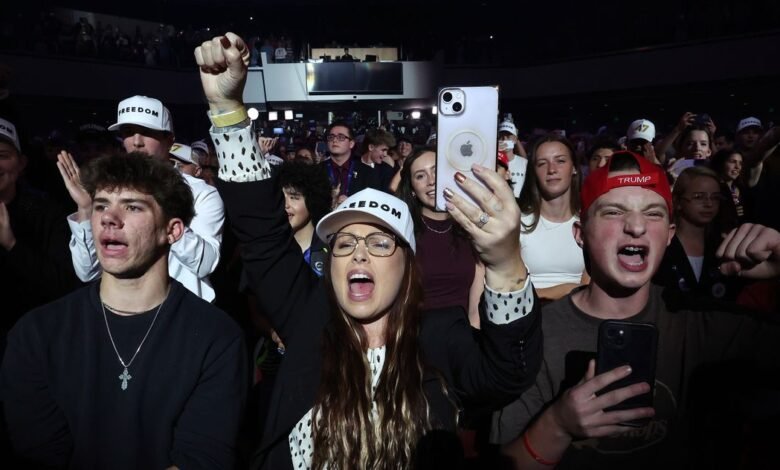

There just aren’t enough of these people to save the GOP in November.
Photo: Win McNamee/Getty Images
In the wake of the GOP’s defeat in Virginia’s recent gerrymandering initiative, a dangerous illusion is arising once again in the Republican ranks: the idea that base mobilization alone can deliver electoral victory.
This is a perpetual temptation for ideologues on both the left and right sides of the spectrum. Why bother with having to compromise your principles in the pursuit of all those confused and selfish swing voters when you can just double down on a hardcore message that motivates the party base to rush to the polls? This has been a particularly durable fantasy for Republicans in recent years since nobody panders to the base like Donald Trump, and he has won two out of three presidential elections without paying the usual lip service to bipartisanship or even public opinion.
This idea popped up after the Virginia voting because it’s clear turnout in deep-red parts of the state was indeed elevated, making the final result closer than many had anticipated. And thus the highly influential Republican strategist Patrick Ruffini spotted a potential path to victory — or at least a better result — in November:
Absent a victory, Virginia provides Republicans with a rare optimistic counterpoint to the building narrative of a Blue Wave. If the fight is framed the right way, Republican voters will turn out the same or better relative to Democrats than 2024, even with an unpopular president in the White House. And if they recreate this performance even to some degree, they are virtually assured control of the U.S. Senate and will hold their own in the House, with a fighting chance to keep their majority …
Republicans beating the spread has less to do with coming up with better defenses of Trump’s policies than it does with getting Republican voters off the sidelines by convincing them that giving Democrats power is really a threat.
Ruffini’s ray of hope for a base-mobilization triumph in November was reinforced by widespread GOP claims that Republicans stupidly let themselves be outspent in Virginia. The one asset the GOP definitely has going for it as the midterms approach is a vast financial advantage in national-party-committee and super-PAC assets, completely obliterating the Democratic advantage in individual candidate fundraising. Might a combination of an ever-raging Donald Trump, a party message warning that a Democratic win will spell an end for America as a country, and unlimited money do the trick? It sure sounds simpler than the hard, perhaps impossible work of convincing swing voters that Trump’s agenda of tariffs, wars, and demonization of minorities will be good for America.
But as left-of-center number cruncher G. Elliott Morris explains, Ruffini’s take is not a convincing interpretation of what happened in Virginia on April 21, much less what might happen nationally in November. For one thing, the close results in Virginia may have resulted more from confusion and ambivalence about the referendum among Democrats and especially independents than from supercharged GOP turnout:
A State Navigate poll (fielded April 10-13) showed true independents breaking hard against the referendum — 56% against and 32% for. Those same independents had favored Spanberger by 24 points in our late October 2025 poll.
And this is the problem with treating the referendum as a proxy for partisan preference. The same voter who voted for Spanberger in a normal partisan election may be unwilling to authorize a Democratic gerrymander five months later.
More generally, Morris argues, Democrats have been consistently winning or overperforming in 2025 and 2026 elections by persuading swing voters, not just by turning out the party base:
A better reading of the evidence is that turnout is helping Democrats at the margins, while persuasion is doing the heavy lifting. That’s exactly what you’d expect in a midterm where the president is dramatically unpopular, voters are sour on the direction the country is heading, and Democratic-leaning voters are highly motivated to impose a check on Trump’s power.
So the Virginia referendum shouldn’t be read as a warning that Republicans can solve their 2026 problem by juicing base turnout. Democrats aren’t just turning out better; they’re winning over vote-switchers at an incredibly high rate.
Polls reinforce Morris’s argument and undermine Ruffini’s. Independents, a voter category in which Trump nearly broke even with Kamala Harris in 2024, are now very consistently expressing unfavorable opinions of his job performance by better than two-to-one margins. A significant segment of Trump 2024 voters are now showing buyer’s remorse. Just as important, the idea that the GOP can outperform Democrats in base turnout seems implausible as well. Putting aside the atypical Virginia balloting over the complex issue of congressional redistricting, polls are showing that Republicans have a long way to go to match, much less exceed, Democratic enthusiasm to vote, as an April 22 Marquette Law School survey found:
Democrats hold an advantage in plans to vote in November, with 77% of Democratic registered voters saying they are certain to vote while 65% of Republicans are equally likely to cast a ballot. A similar difference appears for enthusiasm about voting in November, with 50% of Democrats saying they are very enthusiastic compared to 33% of Republicans, among registered voters. This turnout and enthusiasm advantage boosts Democrats’ edge among those most likely to participate in the fall elections.
If Republicans want to avoid disaster in November, they need a swing-voter persuasion as well as a base-mobilization strategy. It’s not clear Trump knows how to do anything other than preach to the MAGA choir while making promises to swing voters that he cannot or will not keep.
Source link