

Photo: Benjamin Fanjoy/Getty Images
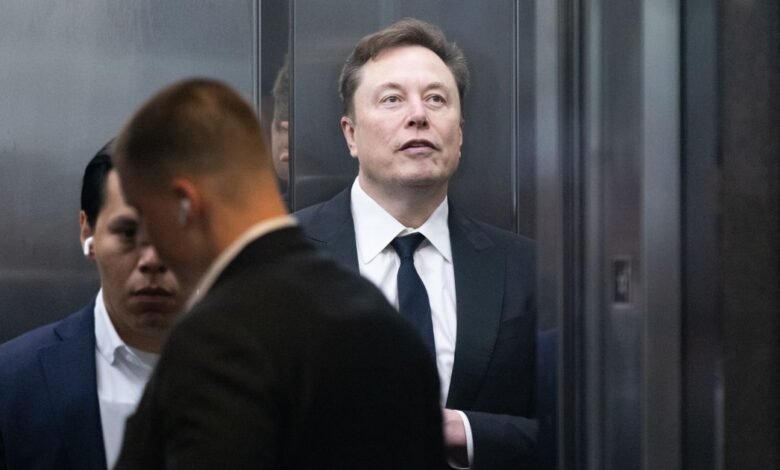
Feuds between the founders of tech companies are quite common, to the point that there is a subgenre of movie about ultra-rich nerds duking it out over the future of their firms. But few of these spats rise to the level of a $134 billion lawsuit—the amount that Elon Musk is suing Sam Altman and Greg Brockman for what Musk considers the gross mismanagement of the company they co-founded in 2015, OpenAI.
The stakes are sky-high for the ChatGPT-maker, as it battles the likes of Anthropic, Google, and Musk’s own xAI for industry supremacy. If Musk is victorious, OpenAI could be forced to pay billions and revamp its corporate structure, putting Altman and Brockman’s roles in jeopardy. Altman and Microsoft CEO Satya Nadella are expected to testify in the coming weeks before the jury decides on liability — an advisory ruling that paves the way for Judge Yvonne Gonzalez Rogers to ultimately decide what, if any, damages to award.
Before the trial began, it was clear that Musk, the richest man in the world, disliked Altman, who has emerged as the face of AI. (Musk claimed that Altman was engaged in a “long con” to turn OpenAI into a for-profit enterprise and that Altman had exploited Musk’s early funding of the company; Altman denied such claims and said he felt bad for Musk, who is obviously not a “happy person.”) But two weeks of testimony, including Musk taking the stand,, has laid bare the extent of the founders’ feud—and the chaotic inner workings of an AI giant. Below are the most jarring revelations so far from a trial that is not only airing out grievances among tech moguls, but which could potentially reshape AI industry power for years to come.
Musk claims to have invested $38 million in the AI company, from December 2015 through May 2017, under the impression that it would remain a non-profit. “If you go nonprofit, you’ve got a sort of moral high ground,” he said, bluntly, in his testimony.
Musk later grew skeptical of Altman’s leadership at OpenAI, leaving in 2018 as the company began pursuing a for-profit structure. Around the time of ChatGPT’s debut in 2022, Musk testified, he came to believe “these guys are betraying their promise.” The lawsuit itself is to recoup what he sees as the share of the profits from the company’s pivot to a for-profit company. “I would have sued sooner if I thought the charity had been stolen sooner,” he testified. OpenAI’s attorneys claim that Musk knew all along about the pivot and that the lawsuit is baseless.
Brockman, OpenAI’s president, testified that Musk threatened him in 2017, when he was trying to pursue total control of the company shortly before his departure.
“I actually thought he was going to hit me,” Brockman said.
It wouldn’t be the only time in Musk’s career that tensions spilled over into a workplace scuffle. Last year, just as he was wrapping up the DOGE mission at the White House, Musk and Treasury Secretary Scott Bessent reportedly got in a fight just before Musk was seen with a black eye at a press conference with the president.
The richest man in the world has previously warned there’s a roughly 20 percent chance that AI could destroy humanity. In his testimony, Musk reiterated that fear , saying that AI “could kill us all.” He said that he wanted a scenario more like Star Trek, in which AI benefits humanity, and “not so much a James Cameron movie like [The] Terminator.”
In the jury trial, Musk has an incentive to hype the destructive nature of AI. After these doomy comments, Judge Gonzalez Rogers warned him to tone down the case for “human extinction” and focus on details about the company.
Altman is a billionaire from prior investments, but says he takes a $76,001 salary as OpenAI’s CEO and has no equity in the company, a nod to the company’s early non-profit vision and his own excitement about artificial intelligence. But other executives at the company are raking it in—including Brockman, who testified that he has made $30 billion as OpenAI’s president.
Musk’s attorney, Steven Molo, hammered home the point that a CEO of a company purportedly founded for altruistic reasons is now extremely wealthy.
“You just happen to be $30 billion richer?” Molo asked.
“Compensation was certainly secondary to the mission,” Brockman responded.
In November 2023, OpenAI removed Altman as CEO because he was not “consistently candid in his communications,” as the board put it in a blog post. Altman was devastated. And texts introduced in the trial show how he plotted to get back.
Altman was texting with interim CEO Mira Murati about the board’s decision and if he could find a way back in. “Can you indicate directionally good or bad,” he texted her at 2 a.m.
“Directionally very bad,” she replied. The board wanted him gone. “They’re convinced about their decision,” she wrote.
“For me to be fired? or some new thing?” he asked.
“Yes for you to be gone,” she replied.
Murati told Altman that the board doesn’t “care if everyone quits.” It turns out she was wrong. Dozens of employees quit and hundreds more signed a letter threatening a mass resignation if the board itself did not step down. Within days, Altman was back and the majority of the board left.
Though Murati helped Altman return to the company, she also testified that he intentionally caused “chaos” among its leaders to better position himself. “My concern was about Sam saying one thing to one person and completely the opposite to another person,” she said in the second week of the trial. When she fought for his return, she felt that OpenAI was “at catastrophic risk of falling apart.”
Source link